
Why Belgium should be your next European escape
Maria Wheeler
Paris Independent Contributor
I'm going to gush a little more about my country of birth. I hope you won't mind. As with many of us immigrants, even though we have made our home here in Canada, an invisible thread keeps pulling us back to the country of our youth. And yes, distance does make the heart grow fonder.
Belgium is often just considered a lay-over, or a quick filler for North American tourists on route from Amsterdam to Rome. Brussels and Bruges are the two cities most often visited on such a lay-over. In my previous travel column, I shared some of the gems you can find in Antwerp, one of my own favourite stomping grounds since I studied there - don't ask me how long ago that is... I hope those tips have inspired you to start rethinking your European travel plans.
There are, of course, other Belgian cities that are more than worth a visit. Ghent boasts a series of UNESCO World Heritage sites. Hasselt brands itself as the "capital of taste" owing to its "jenever" distilleries, "speculaas" cookies, and chocolate production. Ostend is the main city by the North Sea, with a huge white beach and an amazing boardwalk full of restaurants. Louvain is another gem, a student town like Antwerp, Ghent and Hasselt, with an amazingly ornate 15th century city hall that will mesmerize you. Its university is 600 years old, one of the oldest in Europe. All these cities are located in the north of Belgium, the Flemish or Dutch-speaking region. In the south, the French-speaking or Walloon region, cities such as Liège on the Meuse river, or Dinant, which has a citadel perched on the rock overlooking the city, will show you an entirely different side of the country, literally and figuratively. Belgium has so much to offer, all within a span of about 225 km max from the border with Germany to the North Sea. Easily visited by train, or by car if you wish for a bit more flexibility.
Belgium, just like the Netherlands, enjoys a full-on bicycle culture. Kids learn to ride at a very young age and many seniors, some as old as 90, still make weekly outings in group. It's a great way to stay fit, and to spend time with friends you may have known since you were a kid yourself. Bicycling is very safe because most Belgian roads have bicycle paths that are separated from the car lanes by curbs or hedges. On www.fietsknooppunt.be you will discover the prettiest bicycle routes. The trails cover some 90,000 km and are dotted with cafés and restaurants where tired cyclists can enjoy a coffee, a beer (the selection is amazing!) or a meal. The routes take you through the beautiful countryside, along rivers and canals, and into smaller cities and towns, each with its own little treasures.
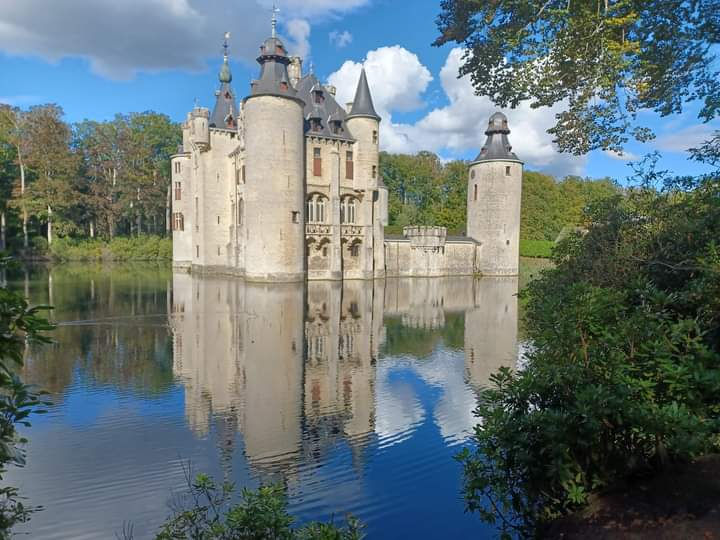
The place where I grew up is a good example. It is home to about 8000 inhabitants and to a castle that was built in the 12th century. Across all those centuries, it was owned by a noble family. The last baron passed away in 1998 and his children sold the property. As with so many of those ancient buildings, the upkeep was most likely prohibitive. Years ago, I had the pleasure of being invited into the castle to view the main floor, a real privilege that I owe to my late dad. It was magnificent: full of antique furniture and books, priceless works of art, and ceilings painted with clouds and herons. Unfortunately, it is not open to the public, but if you're up for it, you can take a walk from the parish church to the castle and back - about 2 km - under a canopy of ancient trees. I swear it takes you back to the Middle Ages. A forest, a castle, turrets, and a moat with ducks. It's like entering a fairy tale.
Our son used to live in a small city called Lier, population about 35,000. It is a lovely place that is located on a river called the "Nete" (doesn't that sound a lot like our "Nith"?). A few years ago, we took a river cruise on the "Nete". Nothing grand: it was just a barge that had room for about a dozen or so people and a guide, but we learned so much about the town's history from that man! And at the end of the ride, the ice cream vendor was waiting for us by the dock.
Lier is the proud owner of a beguinage that used to house a community of lay religious sisters who had "retired from the world". It was founded in 1258 and designated UNESCO World Heritage Site in 1998. The last surviving beguine died in 1994. The beguinage counts 11 streets and 95 small, mostly white 17th or 18th century homes. Walking around this neighbourhood gives you the most peaceful and zen feeling, and makes you want to reach for the rosary in your pocket. It's like walking around in the long ago past.
If you like to people-watch, walk towards the "Zimmerplein", a town square surrounded by eateries and filled with outdoor patios. The square is home to the "Zimmertoren", a tower that was originally part of the town's fortifications. We're talking 14th century of course! In 1930, Louis Zimmer, astronomer and clockmaker, built the Jubilee Clock into the face of the tower. It consists of 12 clocks that encircle a central one. You really ought to sit down for a rest, admire the tower and listen to the beautiful sounds the chimes make.
A few hundred yards from there you will arrive at the main town square, which hides a fascinating memorial. It is a copper circle worked into the cobblestones, on the very spot where in the year 1590 a woman named Cathelyne was burned at the stake as a witch. It states that her courage (she confessed under torture but didn't name anyone else) put an end to this awful superstition in the area.
Lier is one of the many towns and municipalities that adorn the countryside, and they all have treasures to be proud of. Castles, beguinages, city walls or gates, centuries-old churches, abbeys, belforts, renaissance buildings, and very old farm buildings. And you can admire them all while you ride along on your bike. But there is one very special place where a lot of these buildings have been brought together. That place is called Bokrijk. It is an open-air provincial park and museum that displays a large collection of historical buildings from all over Flanders. It is a beautiful place to spend a day, away from the noise of the city. It feels like you've been transported in time. Sound like a theme?
You must have noticed that I love history. When you're a kid, growing up in a European town, this all seems normal, everyday. You don't realize how special it all is. It's not until you're older, or wiser maybe, that you come to appreciate it. And then when you move to North America, you miss it all. That's why I love going back, always ready to discover something new.
A couple of years ago, I came across a pamphlet for the Winter Garden of the Ursulines, and my son and I decided to make an outing of it. It is part of a former international boarding school for well-to-do girls, not far from Lier, led by the Ursuline nuns. In a day and age when women were not yet thought of as being equal to men, these nuns were way ahead of their time, building the school from scratch and becoming such successful entrepreneurs that their profits allowed them to also educate poor girls in neighbourhood village schools. The girls in the boarding school didn't just learn how to do embroidery and recite bible verses; they were taught languages, math and sciences. The Winter Garden, built in 1900, is a magnificent stained-glass dome, where the girls could relax away from classes at times when the weather didn't allow outside walks. It's plain magic and totally worth the visit! But make sure to reserve your tickets in advance, because they book months ahead of time. We were lucky to get in.
Of course, Belgium lived through two world wars. Many buildings were destroyed, in the first war or in the next. Part of the boarding school for instance was levelled and was eventually rebuilt. People who had some money left the city and found lodgings in the countryside, away from the bombing. My grama cooked for some of those families. People who had transportation tried to flee the invading army. My dad, as a child, was put in a truck and ended up witnessing the bombardment of Dunkerque from the back of that truck. But the army had by then overtaken them and they decided to return home.
Both wars left a lot of scars, trauma and death in their wake, as wars do. The countryside still bears witness to that. In small and large ways. Two Canadian soldiers were buried in my hometown cemetery; one was an airman, and the other died while demining the castle grounds after the invading army had fled. Some towns have somewhat larger war cemeteries, but the largest ones are in the west of Belgium, between the coast and the border with France. During the first world war, that was where the heaviest fighting took place and where up to 600,000 soldiers lost their lives. The City of Ypres, destroyed by the fighting, is a place of remembrance for people who wish to pay their respects to soldiers from that war. The Last Post is played every evening at Ypres' Menin Gate to honour the dead. It is a truly moving event that will bring tears to your eyes.
From Ypres it is only a 15-minute drive to Tyne Cot Cemetery, by Passchendaele, where the Canadian Memorial is located. Tyne Cot is the largest Commonwealth cemetery anywhere in the world. It contains the graves of nearly 12,000, mostly unnamed soldiers of the Great War. It is monumental in size, beautiful in its simplicity, but mostly awe-inspiring when you see row upon row of white crosses that name men and boys who were cut down in the prime of their lives. It will leave you speechless. This is Flanders Fields. This is where John McCrae wrote his famous poem. Lest we forget.
I'm sorry. I know this is heavy stuff. You may need to talk it through, debrief so to speak, with your travel mates, over a beer maybe. There is no shortage of that in Belgium. You're in beer country. Stella, Duvel, Hoegaarden, Rodenbach, and Gueuze are among the most well-known. Then there are a number of abbey beers such as Trappist, Leffe, Chimay, and Affligem. Those are just a few of our many foamy brews. My personal favourite is Lindemans Kriek, a cherry beer that is especially lovely on a summer's day. I found it in Niagara-on-the-Lake once, a veritable treat!
It is a mere 45 km drive from Tyne Cot to De Panne at the Belgian coast. Take a stroll along the boardwalk or through the dunes, dip your feet into the sea, or rent a family-size go-cart for some team peddling. Who said you couldn't have a beach vacation in Belgium? My meal suggestion at the coast: try the "tomaat-garnaal", a tomato on a bed of lettuce, stuffed with a delicious North Sea shrimp filling. Fries on the side of course. It's one of my own favourite summer meals.
So please, do go and enjoy my home country. Soak up the natural beauty, the culture, the architecture, the history, and the art. Do the shopping, the beer-tasting, experience the chocolate and culinary treats, do not skip any of it. And, perhaps, rent a bicycle and take a ride along those routes that I mentioned. You won't regret any of it!
About the columnist: Maria Wheeler is a Belgian Canadian who has lived in Paris since 2011. She loves family, travel, colours and beautiful sights. Along with her husband Tim and lab Raven she has recently been exploring Ontario in their travel trailer. They hope to make it to the West Coast later this year.



Comments