
The Goderich Cenotaph: ‘Faithful Service unto Death’
By: David Yates
The word Cenotaph is derived from the ancient Greek term for ‘empty tomb’. Its symbolic imagery was not lost on a people imbued with profoundly Christian ideals after the Great War.
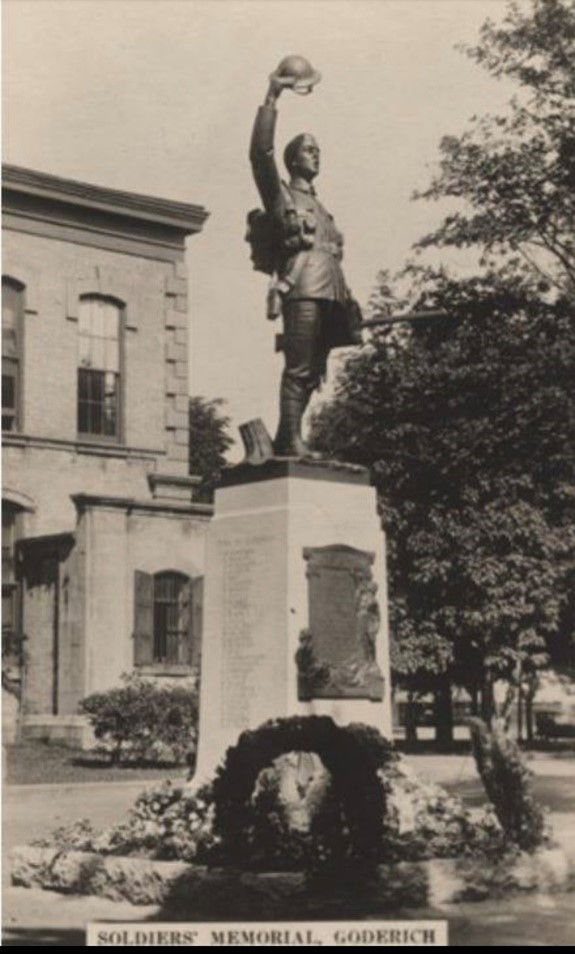
The Goderich Cenotaph facing east on the Courthouse Square is rife with symbolism and meaning.
It is the town’s most hallowed monument raised by a community still in mourning and a noble tribute to those who made the supreme sacrifice.
In November 1918, the Menesetung Canoe Club spearheaded the campaign to erect a soldier’s memorial.
The Huron Signal agreed in an editorial that any memorial should stand as the outward expression of a grateful people for all time.
What was a suitable monument?
Among the suggestions received by the Soldiers’ Memorial Committee were a fountain, courthouse chimes, a memorial hall, and hospital.
The heated debate pitted emotion against budget.
In March 1919, the committee decided on a monument rather than building as the most fitting way to honour what the Goderich Star called the beautiful self-sacrifice made by local youth.
Even before it was decided what form the memorial should take, donations began rolling in from the community.
The Canoe Club made the first $100 contribution to the fund in 1918.
The IODE and other lodges, societies and fraternal organizations made generous donations as well.
At the Peace Day parade on July 19, 1919, in what appears to have been a spontaneous gesture, over $110 in coins were tossed onto the county’s Victory Flag as it was carried around the Square by 12 schoolgirls.
Although the town contributed another $600 to the memorial fund after the Peace Day celebrations, in December 1919, the council refused any further memorial fund requests.
A canvas of the town for funds was made on April 9, 1920, the third anniversary of the capture of Vimy Ridge.
The bulk of the memorial funds came from individuals who gave $1 or $2 donations.
For those people, the Cenotaph was more than just a name carved on the stone. Yet, no design had been chosen yet, and in May 1921 the ‘Star’ advised that the decision should not be hurried.
On March 10, 1922, a public meeting at the town hall finally decided the memorial’s location.
Several thought Harbour Park was the most appropriate spot for the memorial. A strong case was made for the corner of Elgin and Waterloo Streets.
According to the Star, advocates for this site argued there was room for a 150-foot-wide plot in a location not so public as the Square, where certain celebrations might violate the Cenotaph’s sanctity.
Others favoured erecting the monument on Courthouse Square at the head of East Street.
Critics of this site thought that the monument would be hidden by trees and stained by falling leaves.
However, one supporter of the Courthouse location argued that it was by East Street that the soldiers left, they went to the east and came back by East Street.
In the end, the location facing down East Street was accepted.
A Cenotaph facing east may also have had religious undertones as in the Christian tradition bodies were buried facing eastward in the belief that Resurrection Day would come with the rising sun and death would be no more.
Whatever the reason, it is impossible to imagine a more appropriate location.
With the site chosen, design tenders went out to the local papers as well as the Toronto Globe and Montreal Star.
In June, the five-man selection committee announced that famed Montreal sculptor Couer de Leon MacCarthy’s design had been accepted.
‘Leo’ MacCarthy was a well-known artist who received several commissions from across the Dominion to commemorate Canada’s Great War dead.
His ‘Winged Victory’ depicting an angel carrying the body of a slain Canadian soldier heavenward is considered one of the most moving memorials in the British Empire.
‘Winged Victory’ commemorates the Canadian Pacific Railway workers who lost their lives in the Great War and can still be seen at CPR stations in Victoria, Winnipeg, and Montreal’s Windsor Station.
At the substantial cost of $7,600, MacCarthy proposed to mount a 8’6” bronze soldier, which he called the Spirit of Victory atop a 10-foot marble pedestal.
The original proposal was to place bronze tablets with the names of the War Dead on the pedestal's sides.
Later, it was decided to carve the names into the marble pedestal. The bronze tablet on the pedestal's east face was designed by MacCarthy and is emblazoned with the inscription.'
All that this earth can give, they thrust aside. They crowded all their youth into an hour and for one fleeting dream of right they died.'
The Cenotaph was officially unveiled on Dominion Day 1924. According to the Signal, the crowd numbered in the thousands. Anglican Rev. Canon Cody who gave the address called it a service of 'thanksgiving' and 'grateful remembrance' for those who laid down their lives 'For King and Country.'
The Star praised the cenotaph as 'a very beautiful bronze statue of a Canadian soldier cheering for victory.' It was erected in grateful memory to the war dead by a grieving community.
The eternally youthful soldier on the monument faces towards East Street where the 161st Huron Battalion marched to the Grand Trunk Railway station before they embarked for the war overseas. The soldier's helmet is raised in eternal farewell to those who did not return.
Another unique feature of the monument is the tree stump at the soldier's right heel symbolizing a life cut short. The Signal rightly praised it as 'a memorial of which the community may be proud.' As the flag draped cenotaph was unveiled, men doffed hats. A sea of floral arrangements was laid on the courthouse lawn. All understood the cenotaph's sublime meaning that day.
Seventy-nine names of those killed in the Great War from Goderich and Goderich and Colborne Townships are inscribed on the pedestal. This is certainly an underestimate of the area's war dead. Strangely, Charles Mew was listed among them.
In 1936, it was learned that Mew was alive and well and living in Jackson, Michigan. Mew had been wounded but was listed as missing 'after the Vimy scrap.' After a long convalescence in hospital, he was discharged and went to live with relatives in Michigan. Despite the exaggerated rumours of his death, C. Mew's name remained on the memorial.
A bronze tablet with 40 names was added after the Second World War, and, in 1988, 'The Korean War' was inscribed near the pedestal's base. More recently, the soldier cenotaph was in the path of the F-3 tornado which swept through Goderich on August 21, 2011.
It survived the tornado intact. Rob Boyce's image of the soldier's long shadow cast on the Courthouse wall at night has become a near iconic symbol of the town's resilience.
The Goderich Cenotaph remains hallowed ground and a testament to the area's courage and fortitude.


Comments