
Memorial windows of Crediton United Church: Great Love Hath No Man…
- 1 day ago
- 5 min read
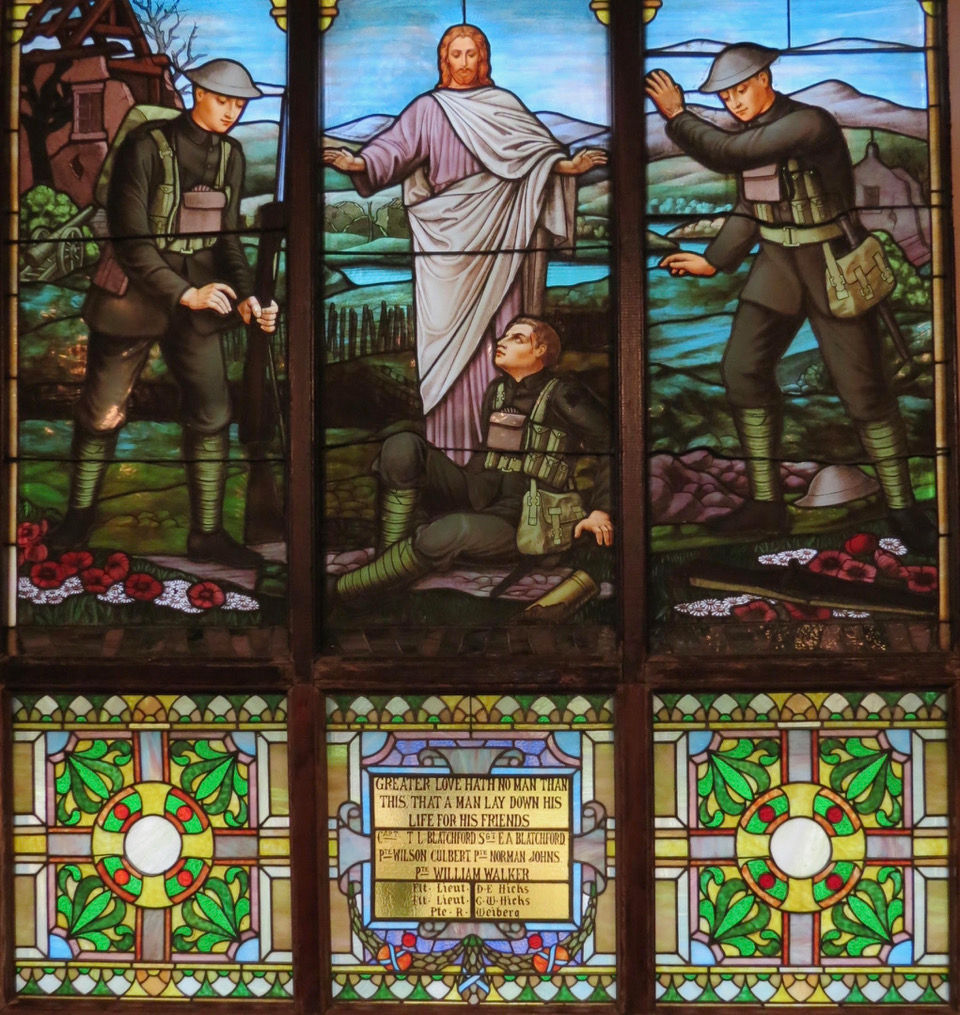
On May 21, 1922, at the dedication service for the newly built Crediton Methodist Church, Rev. Thomas Blatchford held a special evening service to unveil the Memorial window honouring the parish’s war dead.
It was an especially poignant moment for Rev. Blatchford as two of his sons’ names were etched into the glass.
For a church in a tiny village to lose five parishioners was indicative of the sacrifices made by the Great War generation.
Each town, village and hamlet debated on how best to honour the dead. The Methodist Church Women and the Young Peoples’ Society raised the funds.
They commissioned famed Toronto artist William James Meikle. He was a stained-glass maker at Robert McClausand’s studio and Meikle chose the appropriate themes of Sacrifice, Remembrance and Resurrection.
The centre piece of the triptych window depicts Jesus resurrecting a dead soldier, and fittingly, the window faces east.
In Christian tradition, the Resurrection will come from the east.
Flanked on either side of the Christ figure are two soldiers presumably already raised. At their feet are sprays of red poppies, and interestingly, white poppies which were the symbols of pacificism.
Directly underneath the centre piece is the scripture verse from John 15:13 that: “Greater love hath no man, than this that a man lay down his life for his friends.” Under the verse were the names of the five men who had been members of the congregation killed in the Great War.
Its allegorical meaning was not lost on the densely packed church. For Rev. and Mrs. Blatchford, the moment must have been bittersweet.
Their 30-year-old son Thomas had been an estate broker before he enlisted in May 1915. On April 26, 1916, Captain Thomas Blatchford was killed defending his trench in a German raid.
His brother, 23-year-old Ewart Blatchford, was a teacher when he attested in May 1916.
A junior officer’s life in trench warfare was short-lived, it was a miracle that Captain Ewart Blatchford had survived the battles of Arras, Vimy, Hill 70 and Passchendaele. He was killed on August 27, 1918, in the 100 Days battles.
Private William Henry Walker, a local drug clerk, was just shy of his 18th birthday when he enlisted in January 1915 in the 161st Huron Battalion.
He must have been eager to join the fight because, in June 1916, he transferred from the Canadian Army Medical Corps to the 4 Canadian Mounted Rifles, which served primarily as an infantry unit. After several months of trench warfare, in December, Walker was killed by shell fire on December 19, 1916.
Norman Wellington Johns, aged 20, was an Usborne Township farmer. He volunteered with the 161st Huron battalion in March 1916.
He was wounded in May 1917 and returned to duty. On October 26, 1917, at Passchendaele, he received gunshot wounds to the neck and back.
On November 4, he died of those wounds.
A letter to his mother described Johns as a good man with “good heart as a true British hero always does. He died a true hero to save his loved ones at home.”
As a 22-year-old farmer, Wilson Culbert could have stayed home to produce food for the war effort. Instead, his friend Norman Johns convinced Culbert to enlist during “Catch my Pal” week.
When they arrived overseas, Culbert and Johns were soon split when the 161st battalion was broken up in England to provide reinforcements for depleted frontline battalions. Johns was sent to the 58th battalion and Culbert was transferred to the 47th battalion. Private Culbert was killed on September 3, 1918, in the Hundred Days battles.
On May 21, 1922, the day the window was unveiled, the belief that the Great War was the ‘War to End All Wars’ was universally accepted. No one thought on that May Sunday when the names were unveiled that a second war would call the next generation of Canadians to arms.
One young parishioner who may have attended the unveiling was Donald Elliott Hicks, the son of Andrew and Maud Hicks.
Donald, 25, enlisted in the RCAF in September 1940. After his initial flight training at Sky Harbour, Sgt.-Pilot Hicks served as an instructor at several air stations until January 1943 when he was posted overseas.
Flt. Lieutenant Hicks wrote to his parents that he was stationed in Scotland and thought it more like home than anywhere he had been.
In a bombing run over Dusseldorf on the night of November 3, Flt. Lieut. Hicks Halifax bomber was destroyed. Its crew of seven declared missing until German authorities confirmed that all aboard were killed.
At the request of his parents, his headstone has “Our Gallant Don, He Died for His Faith” inscribed on it.
Clifford W. Hicks was the son of Byron and Loretta Hicks. He volunteered for the RCAF in early 1942 and trained as a fighter pilot.
In November 1943, Pilot Officer Hicks married Agnes Isobel Forbes at Ottawa’s Southminster United Church. His marital bliss was interrupted when the demands of the war sent P/O Hicks overseas in early 1944.
Hicks was promoted and posted to RCAF 440 Squadron. RCAF 440 Squadron flew Typhoons, a fast, low flying and highly maneuverable aircraft which provided close air support to the infantry and armour.
On August 8, 1944, Operation Totalize was launched in Normandy. It was still another effort to break through enemy lines.
During the opening stages of the operation, Flt./Lieut. Hick’s echelon of five planes proceeded to make a dive bomb run when, according to the official report, Hick’s plane received “a direct hit and immediately burst into flames.”
The official report stated that Hick’s aircraft hit the ground going 450 mph and exploded into pieces. His death was reported, like so many, in the local paper but it is hard to gauge the depth of the grief the parents and siblings must have experienced. Their inscription on their son’s headstone was “Always will Honour Your Name and Your Glory.”
The last name etched on the Crediton Memorial Window is Private Raymond Frederick Weiberg, of Dashwood, he was the son of Karl and Della Weiberg.
He was enlisted in the Perth Regiment, an infantry regiment, then taking heavy casualties slogging it out in the Italian hills and valleys.
On December 20, the Canadians attempted a river crossing which was stopped by accurate enemy mortar and machine gun fire. In the confused fighting that followed, Fred Weiberg was killed.
Besides his parents, a young widow was left to mourn his loss. The inscriptions on his headstone in Italy read: “He is Gone to the Land Beyond Where There is No Sorrow”. His widow had: “Till We Meet Again” inscribed as well.
The Second World War names were inscribed in the window in 1947. There are few now who can remember the names on the window as living flesh and blood.
Yet, that was the point of Crediton United Church’s Memorial Window; keeping high the torch of remembrance long after the last warrior has gone lest what we forget, we repeat.


Comments