
Trail Talk: An Ode to the Trees and Forests in our Region
- Dec 11, 2025
- 4 min read
Glen Carey was a Maitland Trail landowner since the trail was formed. He was well known for his love of trees and for many years at the closing ceremonies of the Goderich Celtic Festival, he read his ode to the trees.
I thought it fitting that I should feature trees in this Trail Talk column.
Larry Cornelis in Trees Forests and Nature wrote, “If you could do only one thing for our natural environment, it should be to plant an oak.”
An urban forester’s recommendation was that you should plant a tree of a different species to those next to it.
Both people agreed that all the trees should be native ones.
Native oaks support 450 species of butterflies and moths; their caterpillars are an important source of bird food.
Ginkos on the other hand, although very hardy (some survived the atomic bomb blast in Japan), support very few insects.
The most common oak in our area is Red Oak, the most famous one is the Heritage Oak on the Sifto Loop, which began life around 1780.
The next most common oaks in our area are Burr (or Bur) Oaks and White Oaks. There are also some Swamp White Oaks (e.g. in the Mitchell Urban Forest and Goderich square), some Chinquapin Oaks (Chinkapin) one is in the Goderich Courthouse Square and there are a few in our garden.
There are also Pin Oak, Shingle Oak and Scarlet Oak in Courthouse Square, but I don’t know of any other local ones. English Oaks are non-native, and there are some in our garden and one in the Goderich Courthouse square.
Shumard (Swamp Red) Oak and Black Oak are Carolinian oaks so may grow in our area, but I am not familiar with either of them.
Disappointingly two fatal fungal diseases, Oak Wilt and Sudden Oak Death syndrome are spreading in Ontario. Foresters recommend having a mixture of species, as you never know what might cause a big die off species.
Most of us know of the problems of Dutch Elm Disease, Emerald Ash Borer, and Spruce Bud Worm, which have devasted elms, ashes and spruces.
Before 1930 the American Chestnut was one of the most important forest trees until Chestnut Blight, introduced from Japan, destroyed virtually all mature Chestnut trees.
A driveway of Autumn Blaze Maples may look lovely, but one day there may be something that kills them and then the driveway has a row of dead trees.
The Maitland River Valley is at the most northerly edge of the Carolinian zone. Trees such as Hackberries, American Sycamores, Tulip Trees, Ohio Buckeyes, Paw Paws, Kentucky Coffee trees, Black Tupelos and Chinquapin Oaks are at, or close to, their northerly limit here
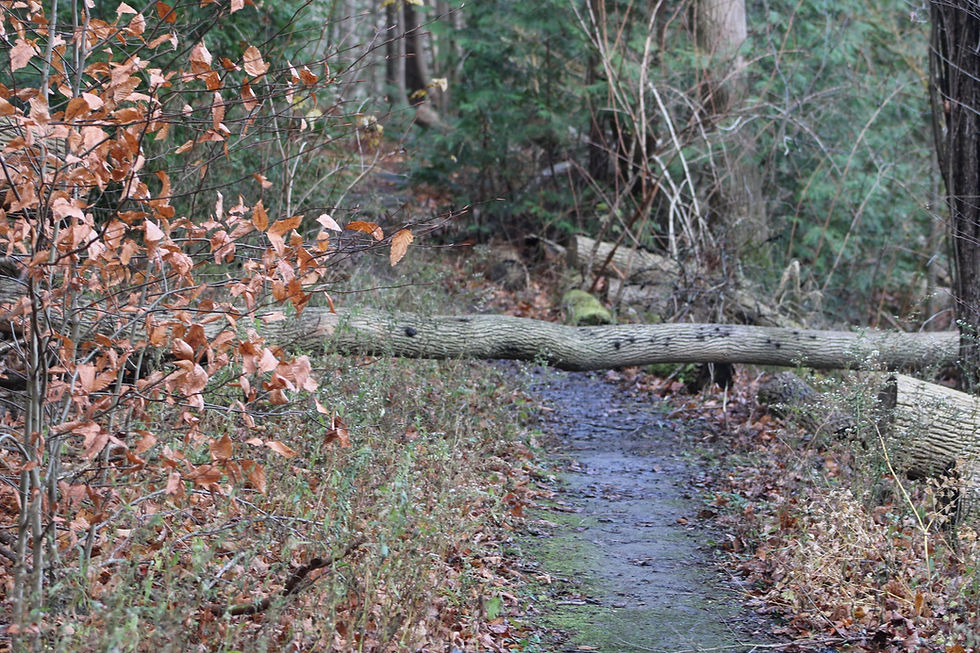
You may well have come across a windfall across a trail recently due to some strong winds. The Maitland Woods had in the order of nine trees across the trail, the Maitland Trail volunteer chain saw crews had a busy day on Tuesday December 2 clearing all of these, before moving on to work on the windfalls on the Millennium Trail.
I noticed windfalls on most of the trails I have recently been on, but surprisingly both the Bannockburn Tract and the Front Road Trail did not have any. This is despite the Front Road Trail having over 100 dead pine trees.
This is the season when it is very easy to eat too much, and a good way to reduce the extra weight gained is to get out and hike or snow-shoe on the many forested trails in our area.
You will also have the benefit of enjoying the restoring effects of being out in our natural environment.
Merry Christmas and a Happy New Year to everyone whether you hike, walk or can’t get out.
NOTES:
The Menesetung Bridge across the Maitland River at Goderich is scheduled to be reopened on Saturday, December 13.
Saturday, December 20 at 9 a.m. - Hike the Maitland Trail and the Robertson Tract trails for about 1.5 hours. For more information and to confirm your attendance, please contact Susan Ethelston at susan.ethelston@gmail.com. This is a Level 1, moderate to brisk paced hike - some uneven surfaces.
Friday, December 26 at 1 p.m. - Hike or snowshoe the Hullett Sugar Bush Trails for about 1.5 hours. Meet at 80602 Wildlife Line. For more information and to confirm your attendance, please contact Patrick at pcapper99@gmail.com
Thursday, January 1, 2026, at 1 p.m. - Falls Reserve Wear off some of the holiday cheer and clear your head by joining us on our traditional hike/snowshoe depending on the weather at the Falls Reserve Conservation Area.
Dress according to the weather conditions.
For special parking information and post hike get-together info, registration is required.
To confirm your attendance, please contact Faye Ribey at fribey@hurontel.on.ca or 519 524-2070 or Wendy Hoernig at w.hoernig@gmail.com or 519 525-6976. This is a Level 1-2 hike with some inclines, moderate paced hike 1 – 1.5 hours. On this occasion only, we have permission to hike beyond the recent more restricted route.
Tuesday Trompers meet at 9 a.m. on Tuesday to hike for about an hour. If you wish to be on this email list, send an email to mta@maitlandtrail.ca
Midweek hikers meet at 9 a.m. and hike for 1.5 to 2 hours on Wednesdays and Thursdays. Contact Patrick Capper at pcapper99@gmail.com


Comments