
Shakespeare’s Optimist members learn about Parkinson’s Disease from someone who has been diagnosed with it
- Jan 15
- 2 min read
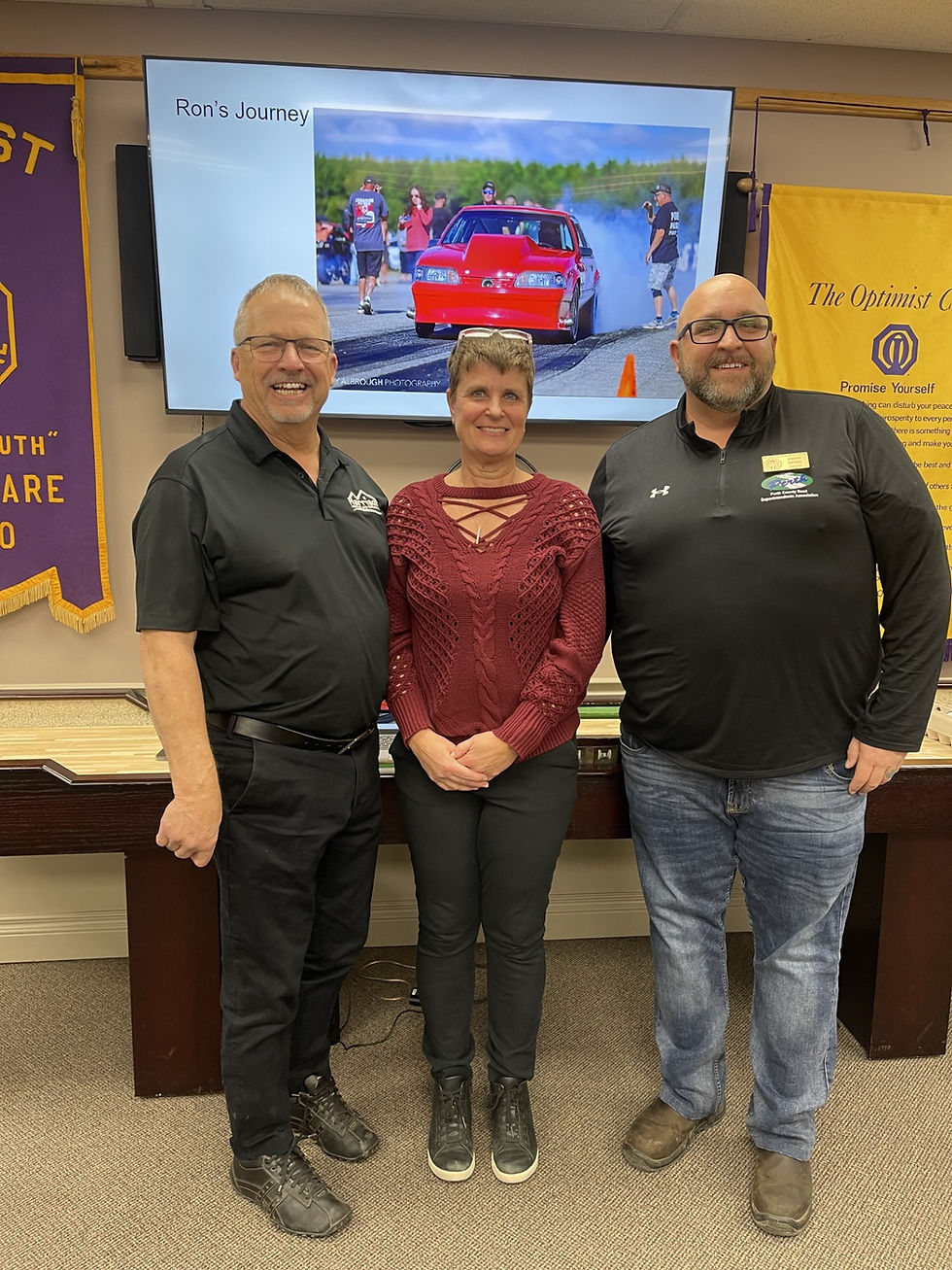
When members of the Shakespeare Optimist Club gathered last week for their monthly dinner meeting, they didn’t realize they would come away with a deeper understanding and knowledge of Parkinson’s Disease like they did.
Shakespeare’s Ron Harrison and Barb Myers spoke to the group and have studied the disease for the last number of years since Harrison was diagnosed with Parkinson’s five years ago.
Harrison noticed a change at first in his cognitive and motor skills and was beginning to have sleep issues and his one hand could be noticeably shaking. He also began to notice numbness in his fingers and very little strength in them.
For Myers, his partner, it took her a long time to believe that Harrison could have something as serious as Parkinson’s.
Myers said she was convinced that Harrison had Parkinson’s after meeting with neurologists, who ordered brain scans, and she began studying what to expect and why Harrison would be diagnosed with Parkinson’s.
She soon realized there are many different types, some are faster moving than others, and because Harrison spent a lifetime as an auto mechanic, with all the fumes that can go with it, would that have brought on the disease?
The doctor and specialist thought most likely not. They were told that Parkinson’s symptoms primarily involve tremors, muscle stiffness, slow movements (bradykinesia) and balance/walking problems, but also could include non-motor issues like loss of smell, constipation, sleep disorders, depression and cognitive changes, often starting years before major movement issues.
The symptoms can vary greatly but progress overtime can affect speech, swallowing and thinking.
The couple have learned there are 38 new people diagnosed with Parkinson’s every day, and three out of five are men.
Studies also show that there appears to be an increase over the last five years.
Mood swings, depression, anxiety and apathy have also been noticed, and are helped with prescribed medications.
Both Harrison and Myers know that memory issues, dizziness and sweating can occur.
They said a medication known as Carbidopa Levodopa is taken four times a day to boost Harrison’s dopamine levels.
Harrison still plays golf three times a week and knows exercise is very important and works out when he can. He makes sure his golf game occurs in the morning when his strength is at its best.
One instance that Harrison relayed to the group is he climbed up a ladder to help on his roof. He was never afraid of heights, but his body movements just froze when he didn’t have the ability to come down.
He also related the experience recently when walking up steps, being able to see light between the outside cement steps also made him stop, and couldn’t continue. Before Parkinson’s that was never a problem.
Myers and Harrison have been involved in the Stratford Parkinson’s walk for years, but once Harrison was diagnosed their team raised close to $90,000 to go toward Parkinson’s research to find a cure.
Myers assured the Optimist Members that all the money raised stays in southwestern Ontario.


I was diagnosed with Parkinson’s disease four years ago. For over two years, I relied on Levodopa and several other medications, but unfortunately, the symptoms kept getting worse. The tremors became more noticeable, and my balance and mobility started to decline quickly. Last year, out of desperation and hope, I decided to try a herbal treatment program from NaturePath Herbal Clinic. Honestly, I was skeptical at first, but within a few months of starting the treatment, I began to notice real changes. My movements became smoother, the tremors subsided, and I felt steadier on my feet. Incredibly, I also regained much of my energy and confidence. It’s been a life-changing experience I feel more like myself again, better than I’ve…