
‘King and Queen of the Pumpkin Patch’ and Depression-era writer are this year’s inductees to Agricultural Wall of Fame
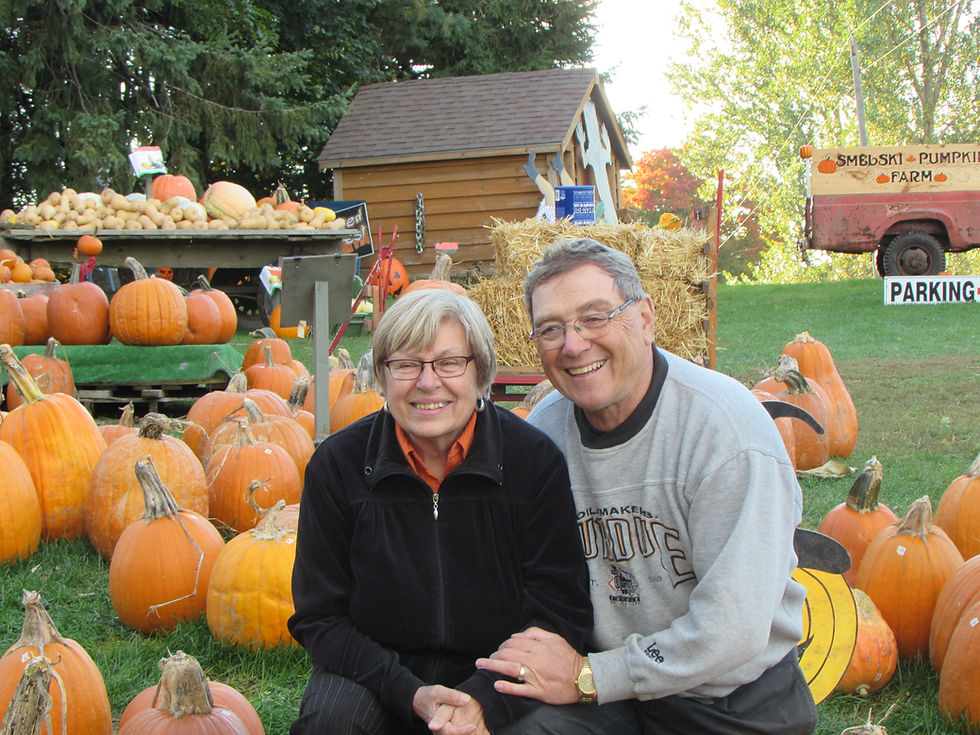
A couple from Shakespeare and a long-remembered Mitchell area dairy farmer and writer are this year’s inductees to the Stratford-Perth Museum’s Agricultural Wall of Fame.
Richard and Jean Smelski of Shakespeare are probably best known for their well recognized pumpkin patch, which they operated as a farm retail business along Highway 7 and Highway 8 for over 20 years. Most area neighbours called them the “King and Queen of the Pumpkin Patch.”
Few people will realize, that the equivalent of their revenue from the pumpkins was donated to community causes, including sponsoring a room in the cancer ward at the Stratford General Hospital, along with their many other noted charities.
In 1973, Richard and Jean became founding members of the Ontario Pork Congress (OPC) in Stratford, where the head office was located in their home on the farm for 38 years, with Jean being the longtime secretary and treasurer.
Richard served as manager of the OPC for many years, as well as its president in 1993. During those many years, he oversaw the entire organizing of the three-day show, which eventually became a two-day show, and is still operating in Stratford to this day, 54 years later.
Richard also helped arrange for internationally recognized speakers for the OPC education program. Meanwhile, as secretary Jean ensured all programs and logistics came together for the third week of June for the show, and during this time, also taught full-time at Conestoga College and raised their two children, Owen and Pamela.
Fostering the OPC was certainly a combined effort of both Jean and Richard as a shared contribution to the swine industry, family and community. At this time, Richard and Jean have both received leadership awards from the OPC and the Ontario Pork Board, in recognition of their contribution to the swine industry.
For over 20 years, Richard regularly wrote articles for the press, notably the Ontario Pork magazine, on various topics pertaining to the swine industry. He often received accolades from the industry and pork producers, for the value of the information that he portrayed.
After leaving his job as swine specialist with OMAFRA in Stratford, and later during his 18 years with Ralston Purina, also as a swine specialist, he received seven Ralston Purina awards, including one with international recognition.
Jean received the King Charles award in 2024 for her volunteer work and community contributions while Richard received the 125th Canadian Commemorative award, recognition for his value over the years to the swine industry.
Jean continues to serve her community as a director with the Stratford General Hospital Foundation, as well as a long-time volunteer at the Stratford Festival. She has been a longtime volunteer with the Shakespeare Opti-Mrs. Club, as well as on the Probus Executive and Friendship Force Organization. Jean is also active in horticulture, travel and serves as an elder at the Shakespeare Presbyterian Church.
Richard, as well as being one of the founding members of the Stratford-Perth Community Foundation, the OPC and the Ontario Pork Industry Council, is currently involved with the Shakespeare Optimist Club, Fryfogel Inn board and Friendship Force, and has also served on the Stratford-Perth Museum board, the Trillium foundation and the Ontario Agriculture Tribunal.
Just recently, Richard and Jean were the producers of a new play at Easter entitled, The Table, which was presented at the Shakespeare Presbyterian Church at the end of March, for two nights of sold-out performances.
In addition to the Richard and Jean, the late Harvey William Ische is being inducted to the wall of fame.
Ische was a Jersey dairy farmer and columnist for the Stratford Beacon Herald from the Mitchell area.
In many ways, his story begins when he started writing a column for the Farmers Advocate at the age of 19 in 1920, using the pen name of “Rusticus.”
He got married to Pearl Rapien in 1928, bought the family farm and took over his father’s herd of Aberdeen Angus. Later that year the herd was found to have tuberculosis and had to be destroyed.
In 1929, Ische took out a loan to purchase three Holstein and three Jersey cows to rebuild a milking herd and become a dairy farmer. To repay the loan, Ische felt he had a “knack” for writing, and went to the editor of the Stratford Beacon Herald, offering to write a weekly column appearing on the editorial page on the Saturday edition. For this effort he earned $2 per week under his Rusticus pseudonym.
He wrote the column on various farming subjects, such as life on the farm and how current and world events affected local farmers in and around Perth County. Some of his columns were also captured in the Farmers Herald magazine, the Montreal Star and the Philadelphia Farm Journal, among other publications.
Ische gradually sold the Holsteins and concentrated on the Jersey breed. He showed 14 of the herd (which he eventually increased to 40 cows) at various fall fairs in Perth and Huron counties. With the help of his sons, he took home many top prizes.
At the Stratford Fall Fair, there was a class of any dairy breed with the best udder.
Ische won the class seven years in a row, and each year took home a winning a silver platter donated each year by the T. Eaton Company Limited.
With a family of seven children, Ische and his wife had a large garden and would sell produce and also churn butter on Thursdays, selling the butter and garden produce at the Stratford Farmers Market on Saturdays. At the same time, his father had started a feed mill during the depression. Men would stop by and work hard just to put food on the table.
In 1938 the banks took over the farms, from farmers who couldn’t pay, displacing them and their families from their livelihood. Ische made it through the “Dirty ‘30s” by making the farm a place of business, thus shutting down the feed mill and custom threshing business to concentrate on milking more cows on their dairy farm.
In June 1938, he purchased a McCormick Deering milking machine from a London firm, making it the first milking machine in Ellice Township in Perth County. For the next couple of months, the herd of Jersey cows were not impressed with the milking machine and showed their contempt for it. On most nights, there were eight to 10 visitors to check out the new milking machine and some people even showed up at 7 a.m. to catch the morning milking with this new modern way to milk cows.
During the depression, men would help for the day to earn food, and many city boys would come to the farm to work for food and lodging at the same time. In 1968, after Ische had passed away, one of the city boys who worked for him when he was a kid came back to the farm. At that point, his son Wayne had taken over. The boy thanked Wayne while telling him that being on the farm with his father was where his life really started in the right direction. He couldn’t say enough good things about Ische and his great demeanour.
Ische always seemed to be ahead of his time and was glad to teach or confer with others, if they were in need of a hand up. He truly cared about the welfare of his family and community, over the many hard-working years of his life.
The induction ceremony for the Smelskis and Ische will be held at the annual Rural Urban Dinner on April 16 at 7 p.m. Hosted by the Rotary Club of Stratford at the Stratford Rotary Complex, tickets and more information are available at https://tinyurl.com/23uchcm9.


Comments