
SDSS engineering students leveraging artificial intelligence in class projects
- Jun 25
- 4 min read
The Stratford District Secondary School (SDSS) engineering students of Mr. Bradshaw’s class are among the most enthusiastic in their studies – and their creative solutions to problem solving projects demonstrates that engagement.
In a combined Grade 11/12 class, the students were challenged to leverage artificial intelligence (AI) to context-engineer professional level computer games. In simple terms, context engineering is the practice of designing systems that decide what information an AI model sees before it generates a response. Context engineering is best used for conversational AI, document analysis tools or coding assistants.
“The science has historically been, obviously, to learn how to program, but AI has irrevocably changed that industry, and one of the things that everyone is struggling with, and what I want the students to learn is, not to just offload, but to learn how to leverage it too,” said teacher Andrew Bradshaw.
Jason Wonnacott created a game called Periodic Gauntlet where there are multiple runs and after each run the player receives currency that can be used to buy abilities and upgrades to take into the next run. It is based on the periodic table of elements using the properties of the element.
Amber Hillis created a text-based jousting game. “I was really struggling with the AI to get it to incorporate my different modules while still not crashing so it’s kind of a little bit more bare than I would like, but you can play it,” she said. With time, she will have it animated but, the project was due that night, so her work was cut out for her.
Ben Bride-McCune built a game making Churros based on a browser game a lot of kids played.
“It’s a series, Papa’s, that started with Papa’s Pizzeria that was drag and drop to make pizzas. There was a donut shop, ice cream sundae place and it would be basically the same formula where you prepare it, you cook it, you top it and serve it, and you just try to get the most amount of money that you can. So, we took a lot of inspiration from that because they hadn’t done one with Churros,” he said. His co-developer on the project is Pasha Rusin-Franke.
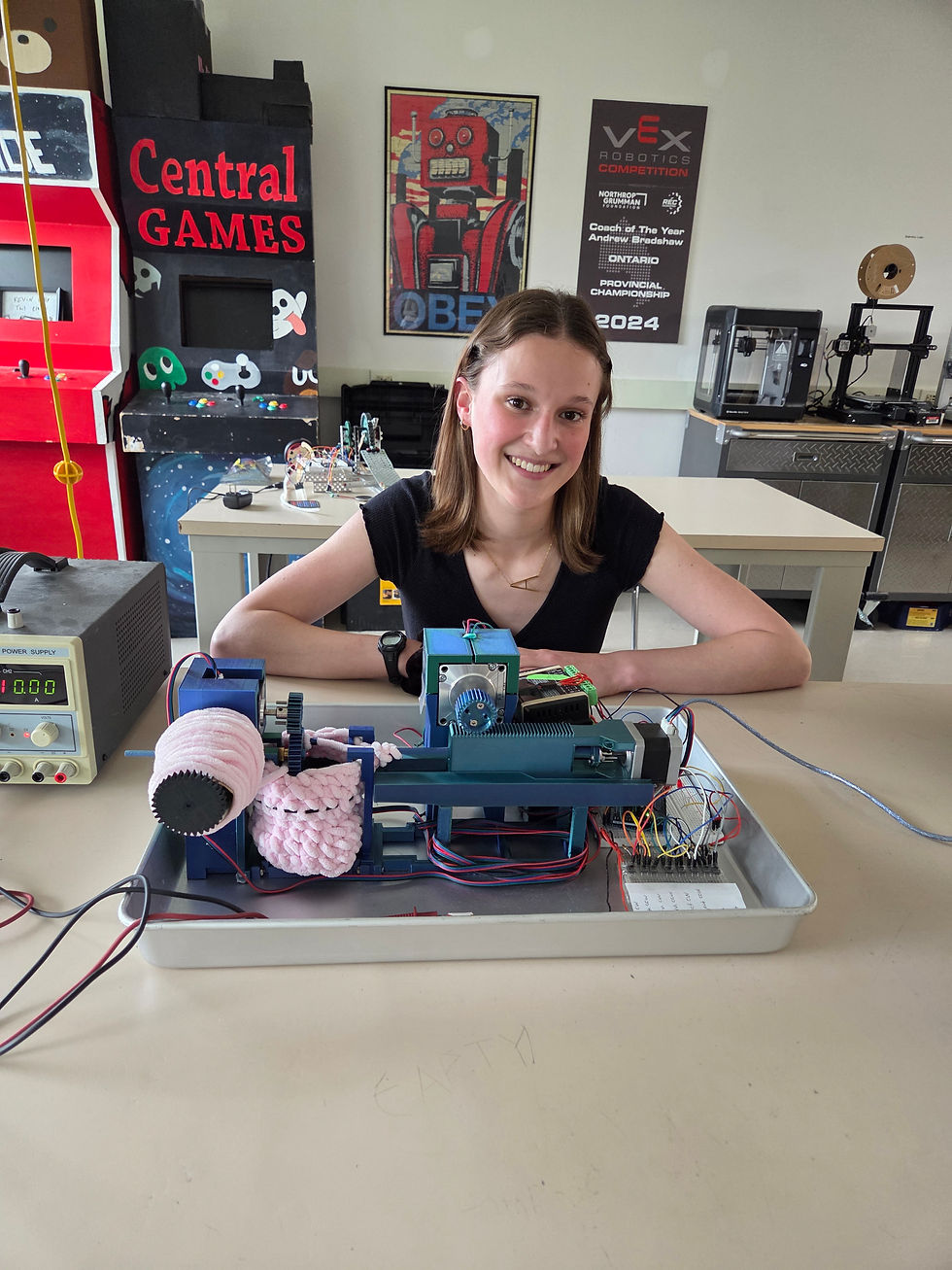
The class was spent testing each other’s games and giving feedback to the developer to help improve. Afterward, graduating student Avery Durand was eager to demonstrate the robot she built that can crochet. The body, crochet hook and gears were 3D printed to Durand’s specifications and the series of motors are powered by 27 volts.
“This is our creative engineering project and everyone in class gets to choose their own project. We work on it all semester and it’s pretty much independent and the other projects are very different. One of my classmates made a musical instrument for people with disabilities. Mine is crochet because I really like crocheting in my own time. It would be good for people with limited mobility because crochet requires a lot of different hand movements,” said Durand.
Her robot runs on button presses. Each button is colour coded and labeled and each controls a different order in a different direction. Using just the buttons, someone can crochet a project, built to do one stitch consistently.
“Going into this, I didn’t really know how to do any of this, so AI was a research tool for me. At first, it helped me pick motor drivers and decide on motors. Once I had all the parts it was much easier to figure it out myself and build my circuit. AI helped me code. As a student we have a basic understanding of different programming concepts and how to define pins. Something AI helped me do was perfect that and code in a way that is functional.
“I think something important when working with AI is to always be questioning what it’s saying because it is overconfident and it is trying to please you at all times. There were sometimes in my project where I was telling it about errors that I was having as I was building in troubleshooting and it would (say), ‘Your whole circuit is broken unplug it right away!’ But it was lying so you just have to keep questioning it because I hadn’t done anything to make my circuit explode like it said,” Durand said.
Another project she has been working on is a hand motion-controlled robot that can draw. Unfortunately, as with prototypes, it encountered network errors that were unresolved in just a few minutes.
It is a promising future for Durand as she prepares to head to McMaster University’s engineering program in the fall. There are many of Mr. Bradshaw’s students that have gone on to study engineering and often return to tell the tale of how prepared they were.
“A lot of past graduates come back and say that it really helps them with preparing for engineering and university: ‘The creative engineering project that he has everybody do in Grade 12; I went to tour schools and it’s almost the exact same as your final design project in first year engineering. The same criteria. You have to find a problem or someone with a disability and make something to solve that problem,’” said Bride-McCune.
Fine words indeed to the testament of the quality of education in engineering at SDSS and leveraging AI as a tool.


Comments