
Native plants described as nature’s best hope
- May 21
- 4 min read

Lisa Timpf
Advocate Contributor
Norfolk Nature speaker event focuses on pollinator plants
Pollinators play an important role in nature, in gardens, and in agriculture. But thanks to climate change, habitat destruction, pesticides, and other factors, pollinators are showing declining numbers. Fortunately, incorporating pollinator plants into gardens and landscapes can help.
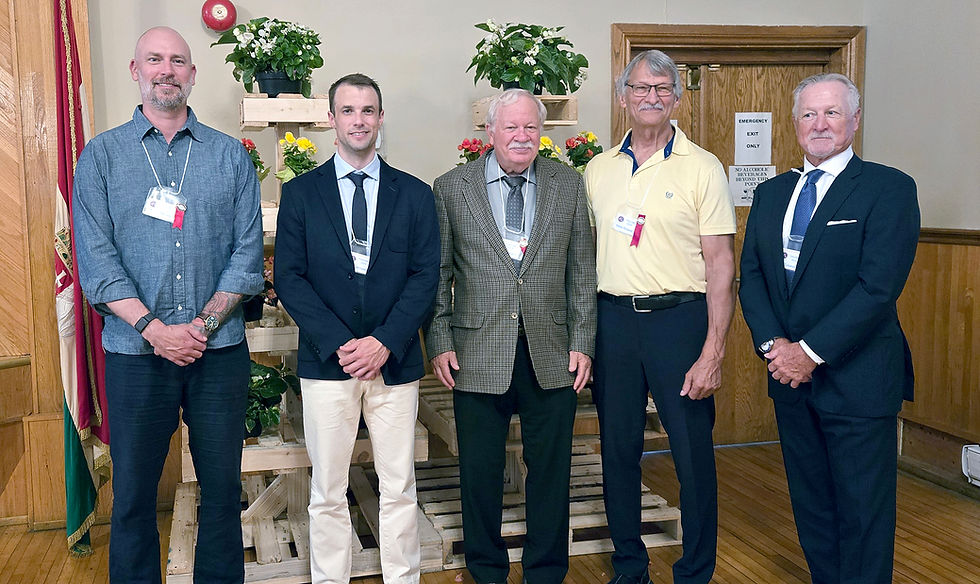
Kevin Kavanagh and Dylan Cowan of South Coast Gardens were the featured presenters at Norfolk Nature’s May speaker event, held at the Simcoe Recreation Centre May 12. In their talk, Kavanagh and Cowan provided information about incorporating pollinator-friendly native plants into gardens.
Pollinators come in a variety of forms, says Kavanagh. Though bees and butterflies may be the first creatures that come to mind, beetles, flies, hornets, wasps, and moths can also serve as pollinators.
Birds like orioles, hummingbirds, and some finches, as well as mammals like bats and small rodents, may also pollinate plants. Some pollinators are nectar specialists, while others are pollen specialists.
Native plants - plants that have historically grown wild in a particular area - are important for pollinators because they have forged ecological relationships that have been functioning for thousands of years.
Though the term “pollinator plants” may bring flowers to mind, Kavanagh notes that trees and shrubs can also attract pollinators.
Some plants have evolved to attract specific pollinators, Kavanagh says. For example, red columbine is well-suited to draw ruby-throated hummingbirds, with its blooming period timed to provide a critical source of nutrients for the birds.
Closed bottle gentian, which has dark blue flowers, is adapted for bumblebees. Bumblebees are one of the few insects strong enough to crawl into the closed flower, where they drink nectar and, at the same time, deposit pollen.
Certain plants, like goldenrod, asters, perennial sunflowers, coneflower, lupins, sneezeweeds, bergamots, and mountain mints, are referred to as “keystone species” because they support many different species of wildlife.
Kavanagh notes the importance of including plants with a variety of flowering periods. For example, asters and provide needed food for late-season pollinators.
While many of us enjoy watching bees and butterflies visiting flowering plants, shrubs, and trees on our property, some plants are designed to appeal to other creatures. Pawpaw trees, for example, attract carrion flies, blow flies, scorpion flies, and beetles.
The Magnolia Acuminata, also known as the cucumber tree, is one of the oldest trees on Earth. The cucumber tree is Ontario’s only native Magnolia species, and Norfolk County and the Niagara Region are the only locations in the province where it occurs naturally.
As one of the oldest trees on Earth, Kavanagh says, the cucumber tree evolved before butterflies, so its pollination relies entirely on beetles, who crawl into the buds before the flowers open.
Though many native plants are helpful for pollinators, their benefits go beyond flowering season. Many perennial plants offer seeds eaten by birds.
Plants like the spicebush provide fruit for migrating thrushes, while also serving as a host plant for spicebush swallowtails and the spicebush silk moth. Hackberry and button bush, as well as trees like oaks, cherries, and maples, also support numerous species.
In the talk, Kavanagh addressed three myths about native plants. First, though some assume native plants should be easier to grow than non-native plants, that’s not necessarily true. It’s important to match plants to the habitat you have in your yard, because some plants need specific conditions to thrive.
Secondly, some believe that plants always behave the same way in our gardens as they do in nature. Again, that’s true only if we replicate the conditions they naturally experience. If you take a native plant and give it fertilizer or more water than it’s used to getting ‘in the wild,’ it may respond differently than it would out in nature.
The third myth is “if it’s wild looking, it must be a native plant.” This, Kavanagh says, is a common misconception. Many weeds that are ‘wild looking’ are not native plants, and native plants tended properly won’t necessarily be wild-looking.
In matching your conditions to plants, Kavanagh says the ‘plant selector’ feature at BirdGardens.ca can be a useful tool.
“It gives you a basic search that matches what you are looking for,” he notes.
Nature’s best hope, says Kavanagh, is the movement toward including native plants in the garden, because areas that lack native plants become like an ‘ecological desert.’
“Even a few small things can help,” he says. “Nature is so stressed and under so many pressures.”
Even if space constraints mean you have to plant in a container, prairie plants like Virginia Mountain Mint, prairie smoke, and stiff goldenrod will survive in a pot.
Though the pollinator plants talk was Norfolk Nature’s last speaker event until the fall, a number of field events, including moth-watching, identifying wild edible plants, and listening for whip-poor-wills, remain on the schedule in the coming months. For more details, see the Norfolk Nature website, https://norfolknature.org/.


Comments