
Linda Schuyler brings homelessness into focus with new documentary: HOME
Casandra Turnbull
Managing Editor
Exploring how people become unhoused and what comes next
For decades, Linda Schuyler has told stories that ask audiences to look beyond stereotypes and confront difficult social issues.
Now, the acclaimed producer who grew up in Paris and went on to co-create one of Canada’s most recognizable television franchises is turning her attention to homelessness. She has one important ask: for viewers to listen before making judgments.
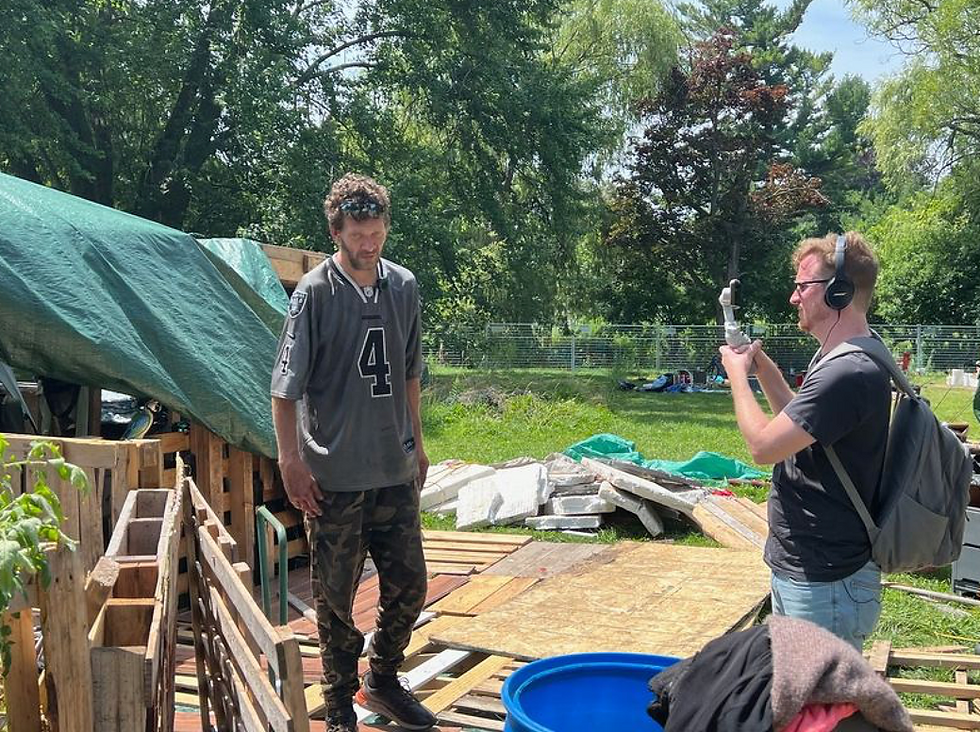
Schuyler’s new documentary, HOME, goes inside an encampment in Cobourg, Ont., introducing viewers to the people living there and the circumstances that left them without a permanent place to call home.
The documentary will begin streaming on TVO on Oct. 9 and air Oct. 10 appropriately timed on World Homeless Day.
For Paris residents, the filmmaker behind the documentary is a familiar name. Schuyler grew up in town, the daughter of longtime former mayor Jack Bawcutt, and has maintained strong ties to the community. The Bawcutt Centre bears the family name, and Schuyler made a $1-million donation a few years ago toward preserving the historic building (formerly Old Town Hall).
Since she left her hometown, her recognition became international as her career in television grew, becoming best known as co-creator and executive producer of more than 500 episodes of the Degrassi franchise. Her work has earned numerous honours, and Schuyler was appointed a Member of the Order of Canada in 1994 and to the Order of Ontario in 2012.
But it was another small Ontario community that planted the seed for her latest documentary titled, HOME.
Schuyler and her husband, Stephen Stohn, have a home near Cobourg. While driving through town, they noticed an encampment growing on the lawn of a grand old house that had once been the summer home of Stohn’s great-grandfather.
“We watched as the encampment grew and I wondered how people ended up there,” Schuyler said in an interview with The Paris Independent.
She began hearing claims from residents that the people living in the encampment had come from elsewhere, including suggestions they had been bused in from Toronto.
“As I got to know the folks in the encampment, I realized this was not true. The majority were from the area. I wanted to get to know them better and try to understand how they had become unhoused. And, as a filmmaker, I wanted to share these stories with others, hoping that it could make a difference.”
The result is a documentary that explores homelessness not as a single story with a simple cause, but through the experiences of individuals whose lives took dramatically different turns. The Paris Independent had an opportunity to pre-screen the documentary ahead of our interview with Schuyler. HOME offers an unfiltered look at homelessness, addiction and the growing housing crisis and puts a spotlight on issues increasingly confronting communities across Canada, including those close to home.
Viewers meet people who have experienced job loss, family breakdown, abusive relationships, grief, addiction and mental health challenges. The documentary also hears from neighbours, business owners, support workers and municipal officials affected by the encampment.
Schuyler deliberately chose not to use a narrator, she explained.
“Homelessness is a very complex societal issue. Apart from people in the encampment, I wanted to talk to people whose lives were affected by the encampment…neighbours, local business people, the mayor, support workers, etc. I did not use a narrator for the film because I wanted each person interviewed to speak in their own voice without third party judgement or explanation.”
Among the experiences that stayed with Schuyler most were those involving parents separated from their children.
Many of the encampment residents had young children who were living with grandparents or other relatives. Some continued to see their children while others had become estranged.
“As I talked to people about their kids, I saw how it caused great pain that they did not have good relationships with their children, but they understood why. Many expressed a sense of embarrassment, not wanting their children to see them in this light. They all wished for a day when they would be re-united.”
The experience also caused Schuyler to reflect on what having a home actually means.
“Gratitude!!! I have been filled with a great sense of gratitude for the home life I have. It is not about my actual house…but about the rich connections with family and friends that I can enjoy as I have the ability to invite them into my home and share food and conversations. It’s also about the ability to have quiet time alone in an environment that feels safe, private, and secure.”
HOME also explores one of the more complicated aspects of public discussions surrounding homelessness: addiction.
Schuyler said drug use is an issue among some people living unhoused, but the relationship between addiction and homelessness is not always straightforward.
“It is hard to tell sometimes if the drugs led to homelessness or if the depression of homelessness led to drugs. Either way, drug use is an issue, as we see in the film. Many of the folks I talked to said they wanted to go to rehab, but the wait list was very long.”
The film also examines what happens when encampments are dismantled and residents are moved, sometimes repeatedly, without permanent housing waiting for them.
“When you move people, they don’t disappear. In the film, we see folks being displaced from a number of locations. But what happens when there is nowhere left to go?” Schuyler said.
The documentary visits a sleeping cabin complex in Peterborough, which Schuyler describes as an important model for providing greater stability while longer-term housing options are explored. The cabins are not permanent housing, she said, but can provide security, support and a safe place for people and their possessions.
Although HOME unfolds primarily in Cobourg, Schuyler believes the size of that community is an important part of the story.
Homelessness is often associated with major urban centres, but she hopes the documentary challenges the idea that smaller communities are somehow removed from the issue.
“Looking at homelessness in a small town like Cobourg breaks down the myth that homelessness is a large urban issue. Homelessness is happening in small communities like Cobourg right across Canada. We can no longer see it as ‘just an urban issue’.”
It is a message with relevance in Paris, she said, even if residents do not encounter a large encampment in their own community.
“We might not currently have a homeless encampment in Paris, but we do in neighbouring Brantford, as we do in multiple small communities across the country. The current issue of homelessness is not something we can turn our backs on. It needs attention, discussion and action. I hope HOME will help make that happen.”
The issue is already close to home. Brantford-Brant’s 2024 Point-in-Time Count identified 389 people experiencing homelessness on Nov. 12, 2024. During the 2023-24 reporting year, 1,147 people experienced homelessness for at least one day across Brantford and the County of Brant, including 638 who experienced chronic homelessness.
As for production of the documentary, Schuyler sees a connection between her approach to HOME and the lessons she learned growing up in Paris.
She recalled watching her father dedicate much of his life to municipal politics and listening to the people he represented.
“I have to believe that my roots, growing up in smalltown Paris, has led to my understanding of the importance of respecting local communities. I observed my Dad, the long standing mayor of Paris, as he lived his life dedicated to local politics. Municipal politics are based in hearing stories from grassroots citizens. My Dad was a good listener and I learnt from him.”
It is an approach she said also informed Degrassi. Although the fictional community was small, its stories about social issues resonated with audiences around the world. With HOME, Schuyler again focused closely on one community in the hope its stories would have a much wider reach.
The documentary does not offer viewers a neat resolution. Schuyler remains in contact with some of the people featured in the film, and their circumstances underscore how difficult it can be to escape homelessness.
“You’ll notice at the end of the film that we say that all of our participants remain unhoused. Unfortunately, this is still true today. Some have been in and out of jail, and one person, I’m very saddened to say, has taken his own life. I will continue to touch base with them.”
Ultimately, Schuyler said she hopes HOME encourages audiences to see the individuals behind an encampment rather than viewing it only as a social problem.
“I certainly hope that by listening to the first-person stories of people living rough, that the viewer will think twice the next time they walk by an encampment. I hope they will see an encampment as a place where individuals have unique, and often heart-breaking stories to tell.”
HOME begins streaming on TVO on Oct. 9 and will premiere on TVO on Saturday, Oct. 10, coinciding with World Homeless Day.


Comments