
HISTORIC ST. MARYS: St. Marys Post Office
- Nov 28, 2024
- 5 min read
By Mary Smith
Because the Canadian Union of Postal Workers is on strike, our local post office has been a centre of attention recently. During its 180-year history, postal service in St. Marys has had its share of public notice. In the early days, the position of postmaster was a government appointment and the political affiliation of applicants mattered. Political decisions rarely have unanimous support. But there was no disagreement about the vital importance of having an efficient, dependable postal system in place. For residents of isolated pioneer communities in the mid-1800s, the mail was the only way of keeping in contact with distant relatives and friends.
In the early 1840s, when settlers first arrived in this area, postal delivery was hit-and-miss. John Ingersoll’s general store, located on Queen Street, became the unofficial post office. Many of the first residents of the village came from the Beachville area in Oxford County – an area that had been settled earlier and already had postal service. Anyone travelling from St. Marys to Beachville for supplies would take outbound mail left at Ingersoll’s store to the Beachville post office. On the return trip to St. Marys, he would bring back letters that had accumulated in Beachville. Later, as roads improved, mail was brought from Stratford to St. Marys by stagecoach.
Thomas Christie was the first official postmaster for the village of St. Marys, appointed ca 1845. He was already in that position when the postal service began keeping records in 1853. Christie, who had been born in Limerick, Ireland, ca 1795, owned a farm in Blanshard Township and had served as township treasurer and clerk. He later sold his farm and bought property on the east side of Water Street in St. Marys where he built a frame building and opened a general store. In the 1851 census, he is identified as a merchant. He and his wife, Margaret, had four children – a 17-year-old son, also named Thomas, and three daughters, age 18, 15 and 11.
At that time, the postmaster operated the post office from his own business premises. The Christie family lived above their store and very likely members of his family assisted Thomas, not only in the store but also with post office service. However, on November 1, 1858, Thomas Christie died in his 63rd year. The St. Marys Argus reported that the funeral would take place from his late residence on Water Street. This left a vacancy for an attractive position that meant a reliable income and even a certain amount of prestige in the community. Thomas Christie Junior, now in his early 20s, was one of the applicants and hoped that his experience working with his father was in his favour. He had competition. On November 11 – just after the death of Thomas Senior – the Argus reported that one prominent citizen had already rushed to Toronto to be the first to submit his application. He was accused of “attempting to snatch the bread from the mouths of a fatherless family.” But Thomas Christie Junior did get the appointment in the end.
By late 1858, the Grand Trunk Railway had begun to run train service through St. Marys, connecting the village to larger centres, such as Toronto, London and Sarnia. Local industries increased production because it was now much easier to ship and to receive goods. The population also increased as new jobs were created. As a result, there was more mail, arriving daily in GTR mail cars. This meant more pressure on the young postmaster to do his work efficiently. Certainly, Thomas would have relied on his sisters to help. His oldest sister, Anne, encountered an older man, George Weir, a civil engineer engaged in railway construction, possibly meeting him in the post office. By late 1859, they had begun to keep company, and Anne believed that he intended to marry her. Weir, however, seduced and then abandoned Anne. To preserve his sister’s honour, Thomas pursued Weir to Eastern Ontario and across the border into New York State, where Weir was arrested for seduction and breach of promise.
On April 12, 1860, the St. Marys Argus noted that George Weir and Anne Christie had been married three days earlier in Buffalo, New York. However, Weir had no plans to live with Anne and certainly no intention of settling down in St. Marys. Some financial arrangement was made and the newly married couple never saw each other again. This pressure, both personal and at work, was too much for young Thomas Christie. In July 1861, he left St. Marys, absconding with as much money as he could find from the post office accounts and from his family’s business. He probably departed on the Grand Trunk Railway – the indirect source of so many of his problems. His mother and sisters left St. Marys soon after and no further records of their lives have been found.
To replace the discredited young Mr. Christie, in September 1861, the government appointed 65-year-old Arundel Hill as the next St. Marys postmaster. He served in that position until he died in May 1870. He and his wife, Frances Sophia (Fanny) Hill, also came from Limerick, Ireland, where, in fact, Thomas Christie Senior had been a friend. When they came to Canada, the Hills purchased the Christie farm in Blanshard Township west of St. Marys. Arundel Hill also took part in township affairs while Fanny opened a small general store in their home and enjoyed getting to know her neighbours. But as he got older, Arundel Hill found the rigours of farming increasingly difficult. Therefore, when he was appointed postmaster, he and Fanny were happy to move into St. Marys. Fanny was 15 years younger than her husband and assisted him in the post office duties. As Arundel’s health declined, she essentially ran the post office but when he died in 1870, it was impossible for her, as a woman, to succeed him. Fanny was a resourceful woman and managed well on her own, investing in property and establishing a business in downtown St. Marys. Later in life, she received an inheritance from an uncle in Ireland that enabled her to enjoy a secure and comfortable life before she died in 1893.
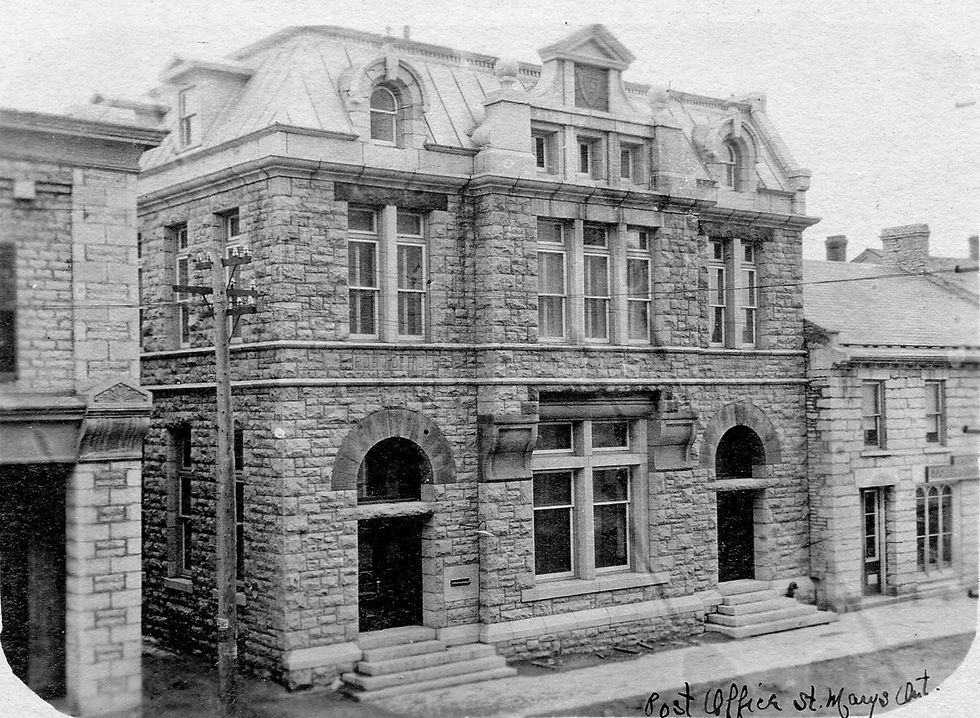
As the federal government’s departments became more established in the late 19th century, the postal service also changed. Post offices were established in buildings separate from the postmasters’ homes. By the start of the 20th century, impressive, government-commissioned, new federal buildings were being constructed across Canada. In 1905, the government purchased property on the east side of Water Street as the site for the St. Marys federal building. Although there were local contractors who bid on – and frequently were awarded – contracts for new post office buildings, for St. Marys the contract was awarded to Robert Cameron of Almonte, near Ottawa. At least local stone was used: the three storey, Romanesque building, shown with this week’s column, was constructed of St Marys limestone with red sandstone trim. The post office occupied the ground floor, with the customs office on the second level. An apartment for the caretaker was on the third floor in rooms under the mansard roof. The building was completed in 1908 at the cost of $40,000.
Following the official opening on June 1, 1908, the local newspapers were impressed not only with the exterior but also with the rooms inside the building: “The interior fixtures in brass and oak are exceedingly handsome as is the interior of the building throughout.” The ceremonial first letter was delivered to 75-year-old Benjamin Tracy, a longtime St. Marys resident. It was his family who in 1854 had built the grand limestone house in Cadzow Park, today the St. Marys Museum. The beautiful building at 17 Water Street South remained the post office until 1957 when a new federal building opened at 35 Wellington Street South.


Comments