
HISTORIC ST. MARYS: J. D. Moore’s Cold Storage
- Nov 14, 2024
- 6 min read
By Mary Smith
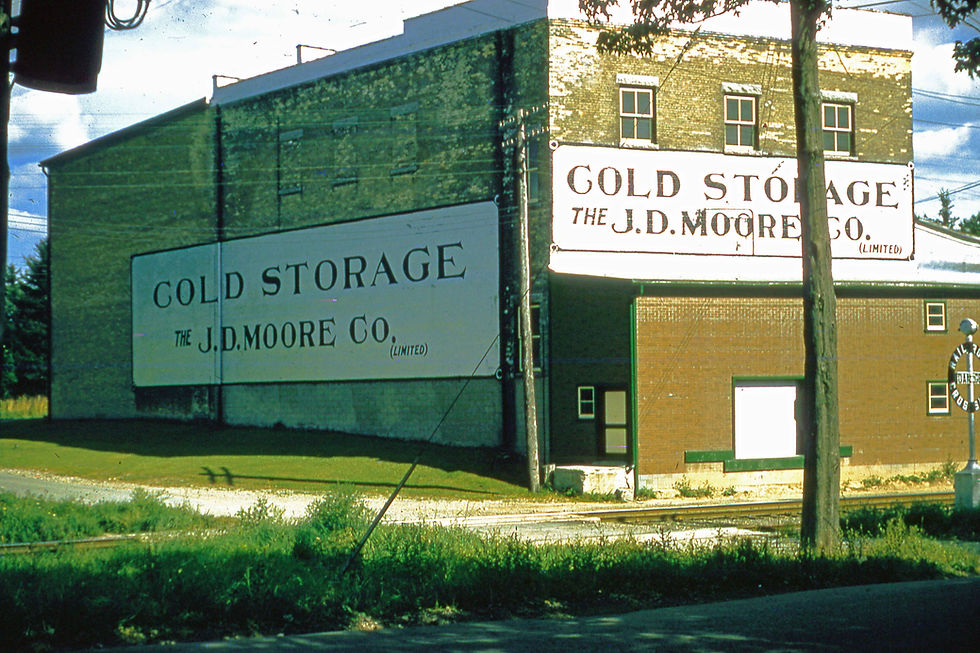
The building shown with this week’s column was a landmark on James Street South for almost a century, and an important local industry for many of those years. The company’s success depended on its relationship with the farming community in the area. This inter-relationship of town and country was a common factor for other local industries – the mills and foundries established in St. Marys in the last decades of the 19th century. J. D. Moore’s industry did not grind grain to produce feed and flour or manufacture and repair agricultural implements. Although he later diversified, his business was initially a dealership in farm produce, especially eggs! J. D. Moore has been introduced in other columns: this one concentrates on his remarkable enterprise.
James Douglas Moore was born in August 1838 on a farm in North Dumfries, near Galt, Ontario. He was the eldest of George and Agnes (Douglas) Moore’s four sons. All four sons were given Douglas as their second name, perhaps an indication of Agnes’ significance to the family’s life – certainly she was helpful to J. D. His father, George, was a prosperous farmer, and there would probably have been a place for J. D. in Dumfries. But wanting to make his own way in the world, J. D. came to St. Marys in 1866 and established a produce business. He and his agents travelled by wagon into the country, paying cash for eggs from area farmwives. He bought up the eggs in the spring and summer when they were plentiful, stored and sold them at a profit in the fall and winter when eggs were scarce. Moore experimented with ways to preserve eggs, making his own improvements to the traditional “glass water” lime solution and preserved large quantities of them in vats. His first “cold store” was a frame building on James Street South near the Grand Trunk Railway freight yards, where blocks of ice kept eggs and butter, also purchased from area farms, preserved through the summer while waiting for shipping at the most advantageous price.
When he came to St. Marys, J. D. Moore brought with him his new bride, 20-year-old Mary Black. They had been married in Dumfries in May 1866. In October 1867, Mary gave birth to a daughter, Agnes, named for J. D.’s mother. But Mary died in January 1869 when little Agnes was only 15 months old. The baby was taken back to Dumfries so that Granny Moore could look after her. On December 29 – less than a year later – J. D. Moore remarried. At that time, widowers often remarried quickly for the sake of their motherless children, but little Agnes stayed in Dumfries with her grandmother. J. D.’s new bride was 26-year-old Elizabeth (Lizzie) Shand whose family had a farm just east of St. Marys. In March 1871, Elizabeth had a stillborn son, but in July 1873, a healthy daughter, Elizabeth (Little Lizzie,) was born. J. D. and Elizabeth had no more children.
Meanwhile, J. D. Moore was building his business. In 1869, the year he married Elizabeth Shand, he built new headquarters – a three-storey commercial block on the southeast corner of Queen and Church Streets, right beside the town’s market square. What space J. D. did not need at street level, he rented to commercial tenants. The upper two storeys provided a spacious apartment for his own family. The property included stabling at the back for his horses and wagons. His agents left from this point to collect eggs and other produce and delivered them to the storage sheds on James Street. As the business grew, more storage space was needed. In 1879, Moore built a white brick warehouse on Elgin Street, between the old cemetery and the railway tracks. The building included a section with thick, insulated brick walls. A railway spur ran beside new loading docks where produce ready for shipping could be loaded onto railway cars.
In a development that was unusual at that time, Lizzie Moore became involved in her husband’s produce business, proving herself both shrewd and competent. In 1878, she left five-year-old Little Lizzie with relatives and travelled to Great Britain on behalf of the company. While there, she met with produce buyers in Leith, Scotland, and in Liverpool, and negotiated contracts for shipments of Canadian eggs and butter. On the way back to Canada, she stopped in New York and met with J. D. Moore’s business contacts there, encouraging them to increase their produce buying.
In November 1880, the St. Marys Argus reported that 20 carloads containing 210,000 dozen eggs were shipped to New York. More shipments were sent overseas to Britain. A decade later, in the mid-1890s, the St. Marys Journal was also impressed: “Very few outside of St. Marys have any idea of the amount of business done in eggs, butter, cheese and livestock at this point. No town in Canada of its population (4,000) can commence to compare with it. Mr. J. D. Moore shipped last week three carloads of eggs to Liverpool and three carloads to Glasgow. There are 12,000 dozen eggs in a carload, so this one shipment amounted to 72,000 dozen or 864,000 eggs. So far in the present season, this firm's shipments have been 35 carloads or 420,000 dozen, making in all 5,040,000 eggs.” By this time, J. D. Moore Company produce included cheese, butter, turkeys, ducks, geese and, in the fall, Canadian apples bound for Scotland.
J. D. Moore diversified, in 1879 buying an oatmeal mill on the Thames River a mile-and-a-half south of St. Marys. In 1888, he purchased the planing mill beside Trout Creek, today O’Leary’s Bar and Grill. It produced window sashes, frames for doors and windows, and decorative trim for house exteriors. In 1897, he was one of the first directors of the St. Marys Cooperative Creamery on Park Street just across from Cadzow Park. It was no longer greatly profitable to grow grain to sell, and the new creamery was established to encourage farmers to turn their attention to other money-making measures – and of course the production of more butter was good for J. D. Moore Cold Storage.
Meanwhile, Lizzie Moore’s business efforts included buying property. In the 1890s, she travelled to Manitoba and bought farmland on behalf of the family. Back in St. Marys, she bought a semi-vacant lot on the northeast corner of Jones and Church Streets, today’s Lind Park. She purchased two houses: one at 266 Jones Street East and its much larger neighbour to the west, 252 Jones Street, a house built in 1886 by a well-to-do widow, Frances Sophia Hill. This became the Moore’s family home. But all was not well within J. D. and Lizzie’s marriage. She came to believe she had not received sufficient financial recognition for her contributions to the company. In a move that must have caused quite a stir in a small town, she threatened legal action against J. D. and left him to stay with their minister and his wife. A settlement was finally reached which, among other conditions, gave her ownership of 252 Jones Street East. She moved back to the house while J. D. went to live in the apartment in his building across from the town hall.
This dispute must have been distressing for the entire family. J. D. Moore himself was ill and died of cancer in 1902. His will divided his assets equally between his two daughters, by this time married women, Agnes Hunter and Elizabeth Turnbull. Elizabeth and John Turnbull eventually sold their shares in the J. D. Moore Company Limited to Agnes and Robert C. Hunter. Lizzie Moore moved to California in 1909 and died there in 1911.
Robert C. Hunter became president of the company, and it continued to prosper under his direction. By 1911, a second storey doubled the cold storage capacity. New “Niagara” electrical power allowed the facility to operate a freight elevator and a system of fans throughout the warehouse. The cold storage could now handle its own produce and offer the public storage space for their produce, including cheese, meats, apples, dried fruits – even summer storage of fur coats. The J. D. Moore Company Limited continued to operate into the 1960s with Robert Hunter’s son, Harold (Hally), succeeding his father. But home refrigerators replaced the need for cold storage space, the company was sold in 1966 and the building demolished in 1973. Halley Hunter retired to Florida where he died in 1974.
Note: Paul King’s research for an upcoming seminar at the St. Marys Museum about the Moores provided a great deal of the information for this column.


I was diagnosed with Parkinson’s disease four years ago. For over two years, I relied on Levodopa and several other medications, but unfortunately, the symptoms kept getting worse. The tremors became more noticeable, and my balance and mobility started to decline quickly. Last year, out of desperation and hope, I decided to try a herbal treatment program from NaturePath Herbal Clinic. Honestly, I was skeptical at first, but within a few months of starting the treatment, I began to notice real changes. My movements became smoother, the tremors subsided, and I felt steadier on my feet. Incredibly, I also regained much of my energy and confidence. It’s been a life-changing experience I feel more like myself again, better than I’ve…