
Hipped roofs and gables: Celebrating the Ontario Cottage
- Nov 5, 2025
- 4 min read
By Dan Welcher
“A wise man, before commencing to build a house, will sit down and count the cost. If his means are limited, he will attempt no ambitious imitation of a particular style. His cottage will be well planned and tastefully built, so that every part will afford quite as much pleasure in its way as a spacious mansion; although not the same kind of pleasure, it will be perfect of its kind.” - “Farm Architecture,” Canada Farmer, 1864
The Ontario Cottage is that modest house. We see them all around here, and in fact, all around the province. The ubiquitous hipped roof, the often-repeated gable over the door, the classic squarish shape are hallmarks of the architecture. They are usually one or one-and-a-half storeys high, though many owners add to the original plan. And they are so omnipresent that most people don’t even notice how unique they are to where we live.
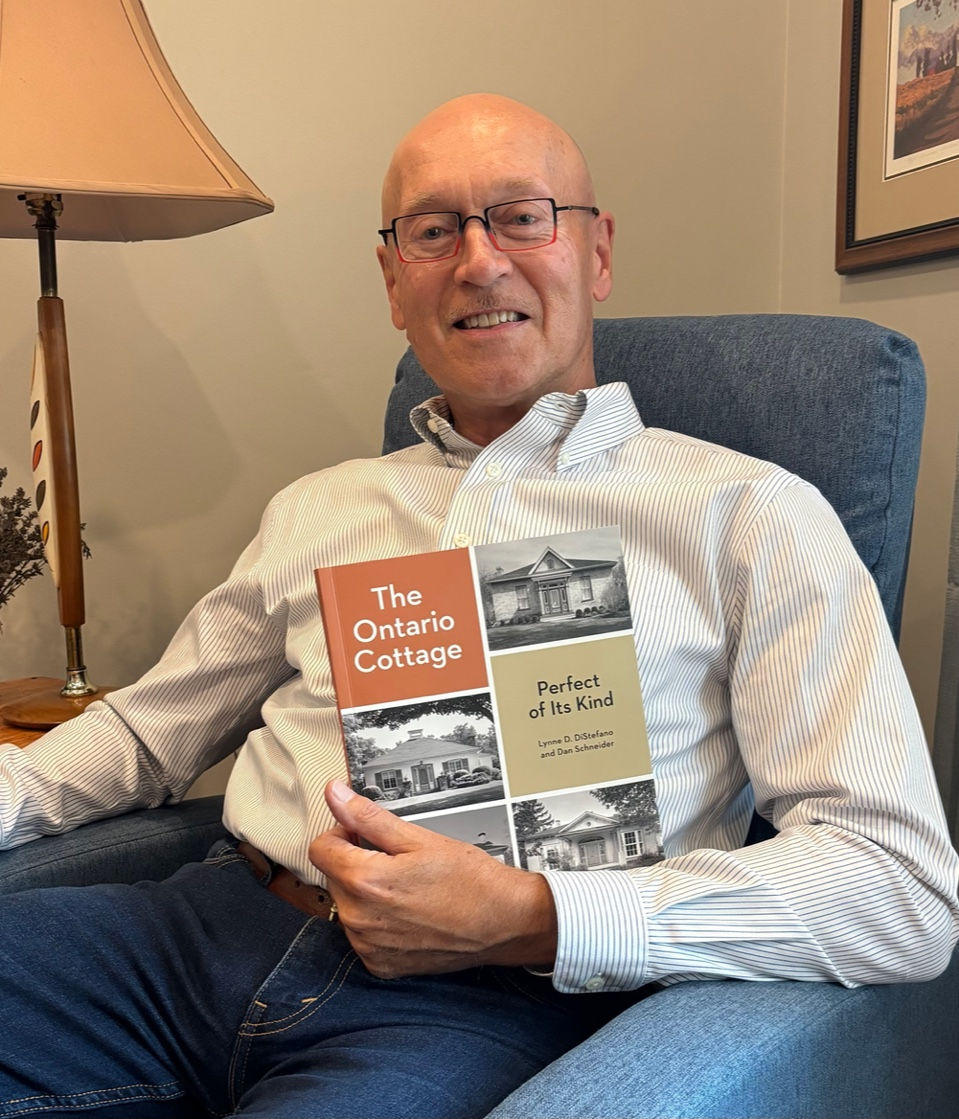
Not anymore. Lynne D. DiStefano and Dan Schneider have made a thorough study of the Ontario Cottage and have written a new book about it: The Ontario Cottage: Perfect of Its Kind. The book, just published, is being launched locally on Nov. 6 at 7 p.m. at the St. Marys Museum.
Dan Schneider, a St. Marys resident, has for 45 years been consumed by a love of these old buildings. During his career, he has been the lead policy expert on many government heritage initiatives, including comprehensive changes to the Ontario Heritage Act in 2005. He currently chairs the policy committee of Architectural Conservancy Ontario and serves as president of the Stratford/Perth ACO branch. I sat down with Dan Schneider to chat about the new book.
Schneider was born in Milverton. Following a BA degree from the University of Toronto, he obtained a law degree at Queens Law School in Kingston. While studying there, he developed a keen interest in the old buildings he saw around him.
“Dad gave me a camera,” he said, “and I just started shooting The Old Stones of Kingston – period houses and other buildings from the mid 1800s.”
Kingston was, for a while, the capital of Canada, and some of its buildings date from as early as 1806. Schneider took photos of many limestone houses, row houses and churches.
“I realized how important it was to preserve them,” he said. “One building in particular, in the mid ‘70s, was the 1844 Mowat Block on Princess Street. It was threatened with destruction and I took part in a demonstration to protest this.”
Soon afterward, the Ontario Heritage Act was proclaimed in Kingston in 1975. Schneider was called to the bar in 1979, but while the study of law was intellectually interesting to him, he found himself uninterested in “going to court and making wills.”
“I went to the Ministry of Culture in Toronto and asked what a law-savvy student could do to help with the preservation of old buildings,” Schneider said. “They sent me to a county archivist, Jim Anderson, in Stratford. He hired me to photograph practically the whole City of Stratford, to begin an archive and to document Stratford at that point in time. It was the first comprehensive photographic study of the city.”
From that position, he went to the Ministry of Culture and worked as heritage easements coordinator. This position put him in touch with the owners of architecturally important old buildings, and registering agreements for their protection. All owners, present and future, must adhere to certain responsibilities pertaining to the alteration of their properties and their upkeep. Buildings like the Opera House and the Queen Street Bridge in St. Marys were protected in this way, as were scores of other buildings throughout Ontario.
“I got to see a lot of the province,” Schneider said. “I came to understand the unique sort of houses we have in Ontario, and in 1990, I found a little stone farmhouse a few kilometres north of St. Marys.”
After approaching the Upper Thames River Conservation Authority, which owned the property, Schneider was allowed to rent it, and to begin the process of repairing it.
“Having fallen in love with this house, which I lived in on weekends, I became aware of the characteristics of the Ontario Cottage.”
He had already met Lynn DiStefano who, at the time, was curator of Museum London. She had mounted an exhibition on Victorian architecture and started a new project about the Ontario Cottage. There was an exhibition in London in 2000, which was supposed to be followed by a book. Working with photographer Steven Evans, DiStefano decided which houses to photograph and feature in the projected book.
But she found herself moving to Hong Kong, and Schneider lost track of her. When they reconnected six years ago, they decided to finally complete the book. It was, for both of them, a labour of love.
Joining them at the book launch Nov. 6 at the St. Marys Museum, starting at 7 p.m., will be representatives of Betty’s Books, and copies will be offered for sale.


Comments