
Goat-a-rich: Goat grazing pilot program a success
By: Kate Smith
Since around 2013, the Town has struggled to control invasive and aggressive vegetation within that corridor adjacent to Sunset Park.
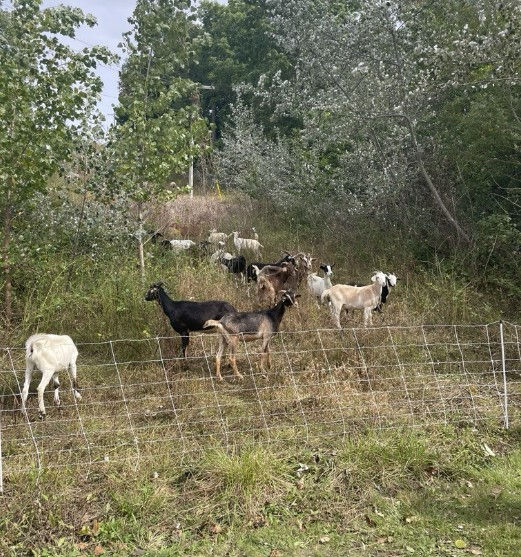
In August, Goderich Council approved a targeted goat-grazing pilot project along the bluffs to manage dense invasive vegetation and improve safe access to critical hydro and water infrastructure.
The goats reduced above ground vegetation over several days, and the cost of the project was valued at approximately $10,000.
“The grazing component of the pilot is now complete, while monitoring and evaluation will continue,” said Sean Thomas, Director of Community Services, Infrastructure and Operations with the Town of Goderich.
“Initial impressions are that targeted goat grazing has potential as one component of vegetation management at this difficult site, although less vegetation was consumed than anticipated.”
Thomas explains that if grazing proceeds in the future, it will likely require more goats, additional grazing time or a combination of both.
Due to the biology and established root systems of the target species, a single treatment is not expected to eliminate them.
“Several treatments, potentially combined with other control methods, may be necessary to achieve long-term control,” added Thomas.
Deputy Mayor Leah Noel emphasizes the power of working in partnership toward a common goal, as this initiative was successfully brought together by the municipality’s Environment Committee, Town Council, and Town Staff, in consultation with the Maitland Valley Conservation Authority (MVCA).
“Each group brought a unique perspective to the table, and it was this collaborative spirit that allowed us to get the pilot project off the ground,” admitted Noel.
Noel says the municipality needs to continue to look for novel solutions to difficult problems.
“Using goats and sheep is a natural, cost-effective way to clear invasive vegetation on an otherwise challenging slope, ensuring we can maintain access to an important infrastructure corridor,” added Noel.
“Ultimately, the best part of this project was its ability to bring people together. From the moment the animals arrived, our community gathered to watch them work and connect with one another. It was truly a beautiful thing to witness.”
Next steps will involve re-seeding the entire site with native species and have an ongoing maintenance schedule in future years. Native seeding is an essential component of this project.
The pilot project will not eliminate the need for monitoring or future maintenance but provides a safer and lower-impact method of eliminating invasive species.


Comments