
Creators of the Classic City: Thomas George Whiteside
By: Gord Conroy
Thomas George Whiteside was a self-made man who served the people and businesses of Stratford for more than 50 years beginning in December of 1912. It was in that year that he established the Stratford Paper Box Company in town at the request of local retailers and businessmen.
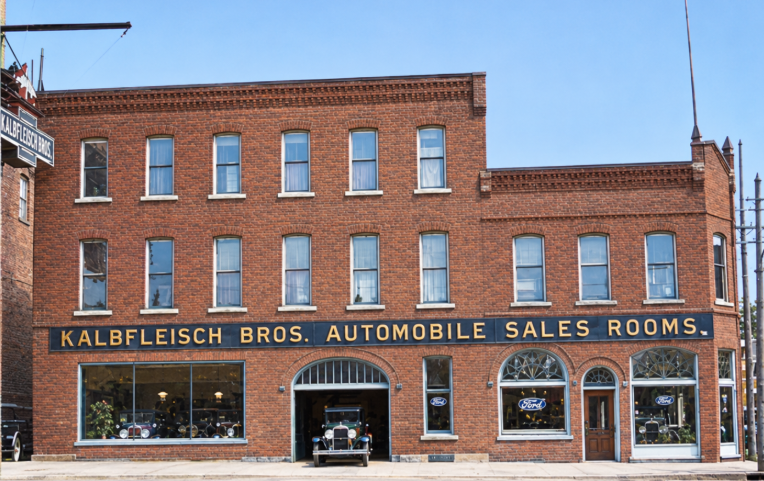
The factory was located on the third floor of 168 St. Patrick St., on the north-east corner of Erie and St. Patrick streets. The building was owned by Kalbfleisch Brothers, which ran its automotive business on the north-west corner of the same intersection but used the first floor of 168 St. Patrick as a new-car showroom and sales centre.
Whiteside made cardboard boxes for many Stratford and area businesses. They were set-up boxes such as those used for shoes or knitted goods. These boxes are distinct from folding boxes as used in bake shops. As owner and proprietor of the Stratford Paper Box Co., Whiteside had one of the longest records in business management in Stratford, beginning in the early 20th century.
Thomas George Whiteside’s father, a butcher in Seaforth, died when Whiteside was seven. He and his younger brother were raised by an aunt there because his mother and older sister moved to Toronto to earn a living as seamstresses. Whiteside stopped school at the end of Grade 8 but worked in the building trades in Seaforth to put a younger brother through high school. By 1900, he moved to Toronto where he worked for the Telfer Paper Box Company for a decade, rising to the position of foreman. He asked for and was granted a leave of absence for six months to set up his own business. He was promised that his position would be waiting for him if he was not successful.
Whiteside never returned to his Toronto position at Telfer’s Paper Box, although he did return there to visit relatives. In 1914, he saw a young pitcher hit a home run on Sept. 5 at Hanlan’s Point ballpark. It was the only home run the young man would hit as an amateur. That same young man also pitched a great one-hit game for the Providence Greys against the hometown Toronto Maple Leafs who lost 9-0. His name? George Herman Ruth, later known as the Babe.
After his marriage in the summer of 1912 in Toronto to Leila Selina Size who was also a seamstress, from Patterson, Ont., now part of Toronto, he moved to Stratford in December of that year. The couple lived for a time at the Queen’s Hotel and witnessed the tragic Knox Church fire with its terrible loss of life in May of 1913.
George Whiteside had considered Stratford or London as possible business sites. Stratford, at the time, was a major rail centre, which was important to him for shipping goods. However, even as a businessman, Whiteside supported R. Thomas Orr in the 1913 plebiscite which stopped the CPR railway from running a rail line along the banks of the Avon River. The park system that Stratford residents cherish is the result.
Whiteside shipped products by rail or truck to many businesses in Perth County and beyond. Destinations included New Hamburg, Kitchener, Galt and Preston (now Cambridge), as well as Clinton, Seaforth, Palmerston and Owen Sound. He also provided boxes for a number of companies in town that included Ballantyne Knit, Williams and Trow (Bentro), Stratford Knit, Avon Knit and Stratford Brass. Some orders were delivered to shops nearby in person through the alley access routes behind businesses. For example, all the specialty candy boxes for Olin Brown candies at 88 Wellington St. were delivered on foot through the alley that ran behind the Wellington and Erie Street buildings.
Thomas George Whiteside was known to be a man of integrity and honour. He paid all debts including those major ones that occurred during the Great Depression when he kept the business running. He also kept people employed in his business at that time, at his own personal expense and gave houses he owned to people renting them in the depression, hoping they might be able to keep them. During his life, he gave time and support to others through the Masonic Lodge, the Knights Templar and various charities.
Thomas George Whiteside is one of many hard-working Stratford citizens who built a business in the city and lived and worked a quiet life serving others. He was also this author’s grandfather.
Taken from Creators of the Classic City: www.streetsofstratford.ca.
“Creators of the Classic City” is an ongoing Times series written by Paul Wilker and Gord Conroy, co-authors of the e-book of the same name. Interested readers can find the free book online at https:// online.fliphtml5.com/ypken/pqiv/.



Comments